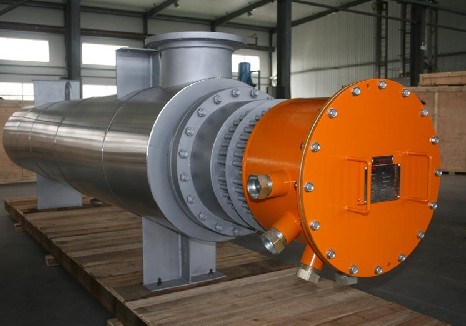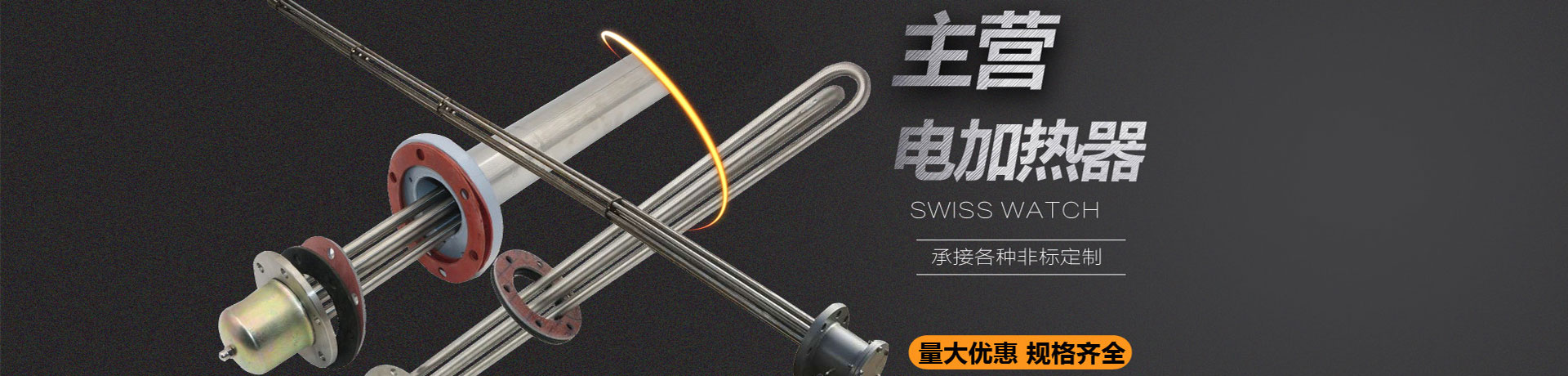
Sheathed Electric Heaters
Sheathed electric heaters (also known as armored heaters or tubular electric heaters) are structured electric heating elements in which a resistance heating core wire is completely enclosed within a metal sheath, isolated from the sheath by high-temperature insulating material. Their core structure, from inside to outside, consists of a resistance heating core wire, a high-temperature insulating layer (such as magnesium oxide powder), and a metal sheath, forming a three-layer coaxial structure of "core wire–insulation–sheath".
Core Features and Advantages
Robust Structure: The fully enclosed metal sheath can resist corrosion from various acids, alkalis, salts, and process gases, with high mechanical strength.
High Thermal Efficiency: The electrothermal conversion efficiency can reach ≥98%, with heat conducted radially through the high-thermal-conductivity insulating layer to the outer surface of the sheath.
Convenient Maintenance: The "core + sheath" separable structure allows replacement of the heating core without draining the oil tank medium, greatly reducing downtime costs.
Wide Adaptability: Can be bent into complex shapes such as spiral, U-shaped, and annular, with operating temperatures covering 300°C to over 2000°C and service life of 10,000-50,000 hours.
Key Points for Selection
Selecting sheathed electric heaters requires comprehensive consideration of medium characteristics, process requirements, installation environment, and other factors:
Clarify the Heating Medium
Liquids: For corrosive media, choose 316L stainless steel or Hastelloy sheaths; for high-viscosity liquids (such as thermal oil, asphalt), surface power density must be controlled at ≤1-3W/cm² to avoid local overheating and coking.
Gases: For flammable gas environments, explosion-proof types must be used (explosion-proof rating such as Ex d IIC T6); for air heating, finned structures should be used to expand heat dissipation area.
Solid/Semi-solid: Such as molten plastics and paraffin, require high-temperature resistant materials (such as Incoloy 800).
Temperature and Pressure Matching
Low temperature (≤100°C): Ordinary 304 stainless steel is sufficient, power density ≤2W/cm².
Medium-high temperature (100~300°C): Use 316L stainless steel or nickel-based alloy, power density 2~5W/cm².
High temperature (>300°C): Requires high-temperature resistant alloys such as Incoloy 800/825, power density ≤8W/cm².
High pressure (>0.8MPa): Requires thick-walled seamless steel pipe sheath + welded flange.
Installation Methods
Flange type: Suitable for heating inside containers and pipes (such as reactors, oil storage tanks), easy to disassemble and assemble.
Threaded type: Used for small pipes or equipment (such as hydraulic stations), simple installation but lower pressure bearing capacity (usually ≤1.6MPa).
Insertion type: Directly inserted into the medium, length customized according to container depth.
Power and Voltage
Power should be comprehensively calculated based on medium mass, specific heat capacity, target temperature rise, and heating time, following the principle of "sufficient without redundancy".
Industrial scenarios commonly use 220V (single-phase) and 380V (three-phase) specifications.
Common Models and Application Scenarios
Model Series Typical Applications Main Features
HRY1/HRY2/HRY3 Hydraulic lubrication systems Flange connection, surface power ≤3W/cm², easy maintenance
SRY6 Series Wind power gearboxes, oil tank heating High power, surface load ≤0.7W/cm² anti-carbonization
SRY2/SRY4 Immersion oil heating Threaded/flange connection, suitable for hydraulic oil stations
BRY Series Explosion-proof applications Explosion-proof rating dⅡCT4, protection rating IP65
Usage Precautions
Dry burning is strictly prohibited; the effective heating zone must be fully immersed in liquid or metal solid.
When heating fusible metals or solid media (such as asphalt, paraffin), voltage should be reduced first until the medium melts, then raised to rated voltage.
Regularly inspect the sheath surface, remove oil stains and carbon deposits to avoid affecting heat dissipation.
If insulation resistance is below 1MΩ after long-term storage, dry in an oven at around 200°C or restore by low-voltage energization.
Sheathed electric heaters are widely used in chemical, power, metallurgy, shipbuilding, food and pharmaceutical, new energy, and other fields for liquid heating, gas heating, mold heating, and other scenarios, and are one of the core equipment for industrial temperature control.