Tubular Electric Heater
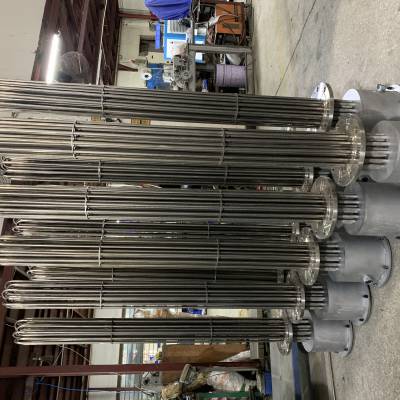
A tubular electric heater (Tubular Heater / Sheathed Heating Element) is the most common and widely used resistance-type electric heating device, extensively applied for heating various media such as liquids and air, covering fields like household appliances, industrial equipment, commercial equipment, and laboratory equipment.
Working Principle
Based on the Joule heating effect, current passing through a resistance wire generates heat, which is conducted through the magnesium oxide insulating thermal layer to the surface of the metal sheath tube, and then transferred to the heated medium. The electrothermal conversion formula is:
Q = 0.2388 · I²Rt
Where Q is the heat (calories), I is the current (A), R is the resistance (Ω), and t is the time (s).
Core Structure
A tubular electric heater consists of the following parts from the inside out:
Resistance heating wire: The heating core, typically made of nickel-chromium wire (Ni-Cr) or iron-chromium-aluminum alloy wire (Fe-Cr-Al)
Magnesium oxide powder filling layer: Possesses both excellent thermal conductivity and electrical insulation, positioning the resistance wire at the center of the tube
Metal sheath tube: The outer tube material is selected based on the application environment, commonly including stainless steel (304/316L/310S), In800, In840, aluminum, copper, low-carbon steel, titanium tubes, etc.
Sealing material: Epoxy resin, silicone, or glass, etc.
Lead-out rod / terminal: Made of stainless steel or free-cutting iron material
Shape Classification
According to different shapes, tubular electric heaters can be divided into:
Straight single-ended heating tubes (single-head tubes / cartridge tubes)
Straight double-ended heating tubes
U-shaped heating tubes
W-shaped heating tubes
Spiral heating tubes
Special-shaped heating tubes (customized bending shapes according to user requirements)
Main Features
High thermal efficiency: Electrothermal conversion efficiency can reach over 95%, with heat directly conducted to the medium
Simple structure and low cost: Mature manufacturing process, can be processed into various shapes after tube shrinking and forming
High mechanical strength: Protected by metal sheath tube, resistant to pressure and impact
Long service life: Long lifespan under correct usage conditions
Safe and reliable: Good insulation performance, some models have explosion-proof functions
Scope of Application
Tubular electric heaters have a very wide range of applications:
Table
Download as table
Export as image
Heating object Typical application
Water Water heaters, boilers, water tank heating
Oil Hydraulic oil, lubricating oil, heat transfer oil heating
Air Ovens, fan heaters, drying equipment
Chemical media Acid, alkali, and salt solution heating
Metal molds Injection molds, hot press molds heating
Low-melting-point metals Melting of salts, alkalis, and low-melting-point alloys
Common Model Series
Table
Download as table
Export as image
Series Applicable scenarios
SRY2, SRY3 types Heating in open or closed oil tanks
SRY4 type Heating of flowing or circulating oil (higher surface load)
SRY2-3 type Three heating tubes as a group, reducing surface load, can replace SRY2 and SRY4
The surface load range is generally 1~11 W/cm², selected according to the medium and working conditions.
Sheathed Type (Special Variant)
Based on conventional tubular electric heaters, there is also a sheathed cable-type electric heating element, which borrows the manufacturing process of sheathed thermocouples, forming a compact solid structure through repeated drawing, reducing diameter, and annealing, with the following outstanding advantages:
Slender shape: Diameter φ1~6mm, length up to 2~60 meters
Good flexibility: Can be bent arbitrarily like a cable, suitable for complex heating environments
High insulation strength: Insulation at room temperature can reach 1000MΩ, about 20 times higher than conventional tubular elements
Good mechanical strength: Can withstand external pressure below 64MPa
Uniform heating: Resistance wire is linearly distributed, basically eliminating uneven heating
Widely used in vacuum electric furnaces, experimental electric furnaces, large drying rooms, tank containers, and special occasions requiring local high-temperature heating.
Usage Precautions
When used by immersion, the heating zone must be completely immersed in the liquid; dry burning is strictly prohibited
Regularly clean scale or carbon deposits on the tube surface to avoid affecting heat dissipation and lifespan
If insulation resistance drops below 1MΩ after long-term storage, dry treatment is required before use
The wiring part should be placed outside the insulation layer to avoid contact with moisture and corrosive media
Select the sheath tube material and surface load reasonably according to the medium characteristics
Related National Standards
GB/T 23150-2024 "Tubular heaters for water heaters" (implemented from April 1, 2025)
JB/T 2379-1993 "Metal tubular electric heating elements"
JB/T 4088-1999 "Household tubular electric heating elements"