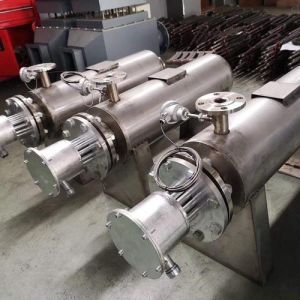
Anti-corrosion nitric acid heaters are heating equipment specifically designed to heat nitric acid during its production and use. Due to nitric acid being a very strong oxidizer, it is highly corrosive to many materials, so selecting appropriate materials and technologies is crucial to extending the heater's service life. Below is an outline of an article about anti-corrosion nitric acid heaters.
Anti-Corrosion Nitric Acid Heater: Material Selection, Design, and Application
Introduction
Nitric acid heaters play an important role in nitric acid production and related industrial processes. However, the strong corrosiveness of nitric acid requires heaters to adopt special materials and designs to resist corrosion. This article will explore the material selection, design key points, and applications of anti-corrosion nitric acid heaters in different industrial fields.
Material Selection
Titanium and its alloys: Titanium has excellent corrosion resistance, especially in low-temperature nitric acid. However, under certain high-temperature and concentrated nitric acid conditions, titanium's performance may degrade.
Incoloy 800HT: A nickel-based alloy that exhibits excellent corrosion resistance in high-temperature nitric acid environments.
Polytetrafluoroethylene (PTFE): As a coating or lining material, PTFE provides excellent corrosion resistance and temperature resistance, suitable for various concentrations of nitric acid.
High-silicon cast iron: Under certain specific conditions (such as low temperature, dilute nitric acid), high-silicon cast iron can be used as a corrosion-resistant material.
Graphite: For some application scenarios, graphite is selected due to its good chemical stability and thermal stability.
Design Key Points
Structural design: Adopt a reasonable structural design to reduce the risk of local corrosion, such as avoiding dead corners and stagnant flow zones.
Temperature control: Precisely control the internal temperature of the heater to avoid local overheating and reduce corrosion risk.
Fluid dynamics: Optimize the fluid flow path to reduce turbulence and eddy currents, which helps reduce corrosion and improve thermal efficiency.
Welding technology: Use high-quality welding techniques, especially for materials like titanium alloys and stainless steel, to reduce the possibility of stress corrosion.
Application Fields
Nitric acid production: Used to heat nitric acid solutions during the production of concentrated and dilute nitric acid.
Chemical industry: In various chemical reactions where nitric acid is used as a reaction medium or raw material.
Metal processing: In metal pickling processes, used to heat nitric acid to improve pickling efficiency.
Pharmaceutical industry: In pharmaceutical processes, used to heat chemical reactions involving nitric acid.
Use Cases
Magnesium nitrate heater: In concentrated nitric acid production, heaters made of corrosion-resistant materials are used to heat magnesium nitrate solution, improving the recovery rate of nitric acid.
Product acid cooler: Made of high-silicon cast iron or stainless steel tubes lined with PTFE, used to cool concentrated nitric acid products.
Nitric acid heater: Heaters made of titanium or Incoloy 800HT alloy are used to heat nitric acid solutions.
Conclusion
Anti-corrosion nitric acid heaters can significantly extend the service life of heaters and ensure efficiency and safety during nitric acid production and use by selecting appropriate materials and design strategies. Through continuous technological innovation and advances in materials science, future anti-corrosion nitric acid heaters will further improve their corrosion resistance and thermal efficiency.