
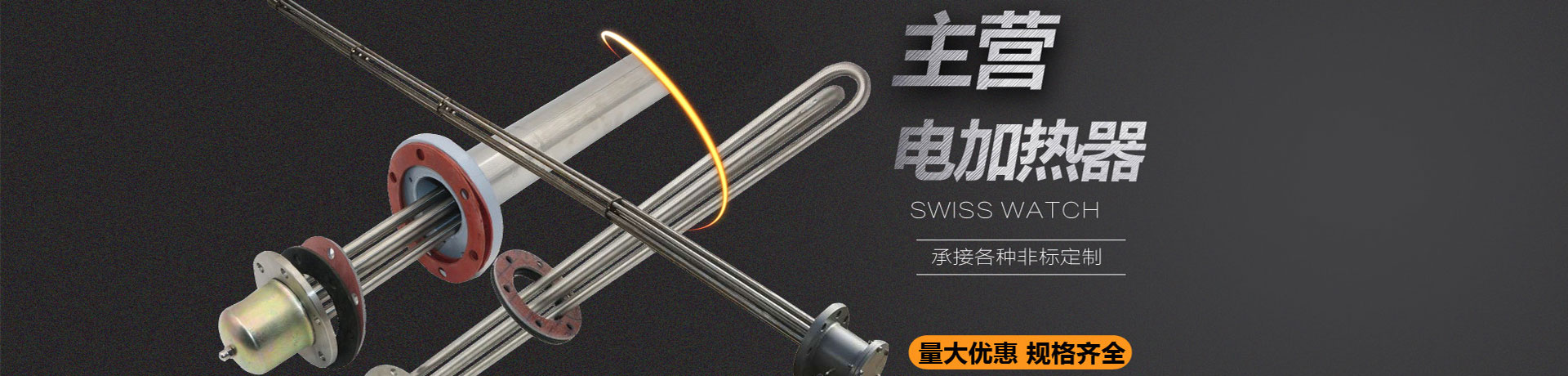
They are the most widely used electric heating elements in industrial and civil applications. They convert electrical energy into thermal energy and feature a simple structure, high thermal efficiency, easy installation, and long service life.
Combining the trends in materials science and intelligent manufacturing for 2025-2026, here is an in-depth analysis of tubular electric heaters:
1. Core Structure and Working Principle
- Structural Composition:
- Heating Wire: Typically made of nickel-chromium alloy (Cr20Ni80) or iron-chromium-aluminum alloy, responsible for generating heat.
- Insulating Filler: Magnesium oxide powder (MgO), high purity, high thermal conductivity, and high insulation, filled between the heating wire and the metal tube to secure the wire and conduct heat.
- Metal Sheath Tube: Depending on the medium, materials such as stainless steel (304/316L), titanium tube, Incoloy, quartz glass, or fluoroplastic (Teflon) are selected.
- Sealing Material: Silicone, epoxy resin, or ceramics, used to seal the tube ends to prevent moisture ingress that could reduce insulation.
- Terminal Connections: Contact points for leading out current, often equipped with explosion-proof boxes or waterproof covers.
- Working Principle: Current passes through the high-resistance heating wire to generate Joule heat, which is conducted through the dense magnesium oxide powder to the metal tube surface, then heats the surrounding medium (liquid, gas, or solid) via convection, radiation, or conduction.
Liquid heating (most common):
Applications: Water tank heating, oil tank heating, chemical reactors, electroplating baths, boiler feedwater.
Characteristics: Lower surface load (typically <2-3 W/cm²), must be fully submerged to prevent dry burning.
Materials: 304/316L for water; 304/321 for oil; titanium tube or Teflon coating for strong acids.
Air/Gas heating:
Applications: Ovens, hot air circulation systems, auxiliary heating in air conditioning, pipeline gas preheating.
Characteristics: Medium surface load, often used with fins to increase heat exchange area.
Materials: Stainless steel, carbon steel (low temperature).
Solid contact heating:
Applications: Mold heating (injection molding machines, die-casting machines), 3D printer heated beds, flat vulcanizers.
Characteristics: Requires tight contact with the heated body (often cast into aluminum/copper or inserted into holes), higher surface load.
Materials: Stainless steel, mica-wrapped.
B. Special Functional Types
Flanged electric heating tubes: Easy to disassemble and replace, commonly used in large storage tanks and pipelines.
Threaded electric heating tubes: Screwed directly into equipment for compact installation, commonly used in small water heaters and coffee machines.
Custom-shaped tubes: U-shaped, W-shaped, spiral, serpentine, etc., to adapt to complex spaces.
Explosion-proof electric heating tubes: Junction boxes use explosion-proof structures for hazardous areas such as petroleum, chemical, and coal mining (Ex d IIB T4, etc.).
4. Key Parameter Selection Guide
When selecting or designing electric heating tubes in 2026, the following parameters must be confirmed:
Voltage and Power:
Specify voltage (220V/380V/480V, etc.) and total power. Note: For three-phase 380V, there are star (Y) and delta (Δ) connections; incorrect wiring can cause a 3x power deviation or even burnout.
Surface Load (W/cm²):
In still water: 1-2 W/cm²
In flowing water: 2-4 W/cm²
In still air: 0.5-1.5 W/cm²
In flowing air: 1.5-3 W/cm²
In oil: 1-2.5 W/cm²
Excessive load can cause scaling, red-hot surfaces, or even melting.
Material Matching:
Pure water/drinking water: 304 stainless steel.
Seawater/chloride-containing: 316L stainless steel or titanium tube.
High-temperature oil (>300℃): 321 or 310S stainless steel.
Strong acids/bases: Titanium tube, Hastelloy, or Teflon coating.
Installation Dimensions:
Total length, heating zone length (non-heating zone must not be energized), diameter, flange standard, thread specifications.
Environmental Requirements:
Is explosion-proof required? Waterproof rating (IP65/IP67)? Built-in temperature control needed?
5. Common Faults and Prevention
Leakage/Tripping:
Causes: Moisture in seals, moisture absorption by insulation powder, sheath tube rupture.
Countermeasures: Use high-quality sealing compounds, regularly test insulation resistance (cold state should be >50MΩ), avoid mechanical damage.
Dry Burning and Breakage:
Causes: Low liquid level or powering on without submersion.
Countermeasures: Must install liquid level interlock protection or temperature limiters; never power on without liquid.
Severe Scaling Leading to Overheating:
Causes: Hard water quality, excessive surface load.
Countermeasures: Choose low surface load designs, descale regularly, or select anti-scaling coated products.
Terminal Burnout:
Causes: Poor contact, loose screws, excessive current.
Countermeasures: Regularly tighten screws, use high-temperature resistant wires, ensure junction box ventilation and heat dissipation.
6. Market Reference Prices (2026 Estimate)
Prices are significantly affected by material, power, and customization level:
Ordinary 304 stainless steel (household/small industrial): Approximately 30 - 80 RMB per piece (1-3kW).
Industrial-grade 316L/flanged: Approximately 150 - 400 RMB per piece (3-9kW).
Special materials (titanium/Hastelloy/explosion-proof): Approximately 500 - 2000+ RMB per piece.
Intelligent integrated types (with sensors/IoT): Premium of about 30%-50%.
7. Safety and Maintenance Recommendations
Grounding Protection: The metal shell must be reliably grounded to prevent electric shock.
Energize after medium is present: For liquid heating, ensure the medium fully submerges the heating tube before powering on; when shutting down, cut power first, then drain the medium after residual heat dissipates.
Regular Inspection: Measure insulation resistance quarterly, and check terminal tightening annually.
Prevent Overheating: For air or mold heating, must be equipped with independent over-temperature protection devices (e.g., KSD thermostat) to prevent loss of control.
If you need selection calculations for specific media (e.g., thermal oil, concentrated sulfuric acid) or need to verify certification standards for a particular explosion-proof electric heating tube, please let me know!