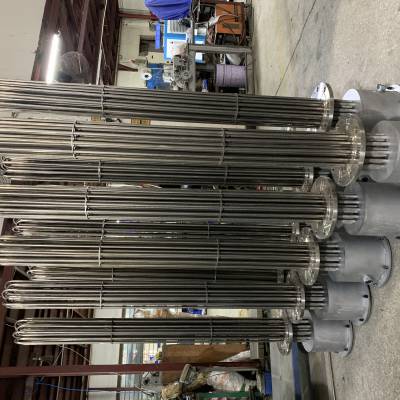
Tubular Electric Heater, usually abbreviated as electric heating tube, is the most widely used electric heating element in industrial and civil fields. It converts electrical energy into thermal energy, featuring simple structure, high mechanical strength, high thermal efficiency, safety and reliability, and easy installation.
Below is a detailed technical analysis of tubular electric heaters:
1. Core Structure Principle
A tubular electric heater consists of the following key components, forming a "sheathed" structure:
Heating wire (resistance wire): Usually made of nickel-chromium alloy (e.g., Cr20Ni80) or iron-chromium-aluminum alloy, serving as the heat source.
Insulating filler: Magnesium oxide powder (MgO). This is the core material, filled between the heating wire and the metal tube. It has good insulation, thermal conductivity, and high-temperature resistance, quickly transferring heat to the tube wall while preventing leakage.
Metal sheath tube: The outer metal tube that protects internal components and transfers heat. The material is selected based on the application environment (see below).
Sealing material: Usually silicone, epoxy resin, or ceramic, used to seal the tube ends to prevent moisture ingress that could degrade insulation performance.
Terminals/lead rods: Connect to the external power supply.
Working principle: Current passes through the high-resistance heating wire, generating Joule heat (
Rt ), which is conducted through the densely compacted magnesium oxide powder to the metal tube surface, and then the tube surface heats the surrounding medium (air, water, oil, or solid) via convection, radiation, or conduction.
2. Common Materials and Application Scenarios
Choosing the appropriate tube material is key to ensuring heater lifespan and safety:
Table
Tube Material Characteristics Typical Application Scenarios Maximum Surface Temperature (Approx.)
Stainless Steel 304 (SUS304) Good corrosion resistance, cost-effective Ordinary water tank heating, food machinery, general air heating ~600°C
Stainless Steel 316/316L Strong resistance to acid and alkali corrosion, contains molybdenum Chemical liquids, seawater heating, electroplating tanks, highly corrosive environments ~600°C
Stainless Steel 321 Good high-temperature performance High-temperature air heating, hot air circulation systems ~700°C
Titanium Tube (Titanium) Extremely strong resistance to seawater and chloride ion corrosion Marine aquaculture, electroplating chromic acid solution, strong oxidizing acids ~300°C (in water)
Quartz Tube Good heat transmission, resistant to rapid heating and cooling Infrared drying, halogen heating, applications requiring rapid temperature rise ~900°C
Carbon Steel/Iron Tube Low cost, not corrosion-resistant Dry air heating, mold heating (requires anti-corrosion coating) ~500°C
Incoloy 800/840 Excellent high-temperature resistance and anti-carburization capability Extreme high-temperature environments, industrial furnaces ~900°C+
3. Main Classifications
Based on installation method and purpose, they can be divided into:
Single-head heating tubes (single-end lead): One end is sealed, and leads exit from the other end. Commonly used for mold heating and embedded installation in equipment.
Double-head heating tubes (double-end lead): Leads at both ends. Commonly used for immersion heating in water tanks and oil tanks, providing more uniform stress.
Flanged heating tubes: Multiple tubes welded onto a flange plate, installed as a whole on large containers or pipelines, offering high power and easy replacement.
Threaded heating tubes: The tube end has threads, allowing direct screwing into equipment threaded holes for good sealing.
Finned heating tubes: Metal fins are wound or embedded on the tube surface to increase heat dissipation area. Specifically used for air heating (e.g., duct heaters, fan heaters) to prevent tube burnout due to poor heat dissipation.
Shaped heating tubes: Customized into U-shape, W-shape, spiral, etc., according to equipment shape.
4. Key Design Parameters and Calculations
When designing or selecting, the following parameters must be considered, otherwise burnout is highly likely:
A. Surface Load (Watt Density)
This is the most important indicator, referring to the power per unit surface area (
). Excessive load causes the tube surface temperature to rise sharply, shortening lifespan or even causing melting.