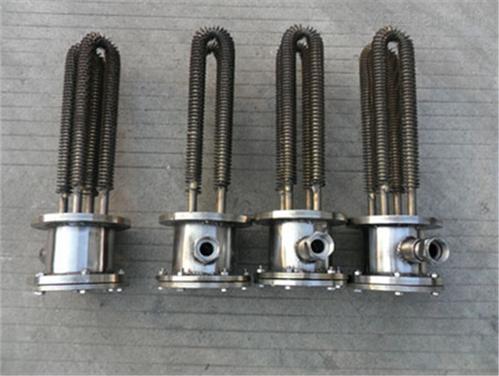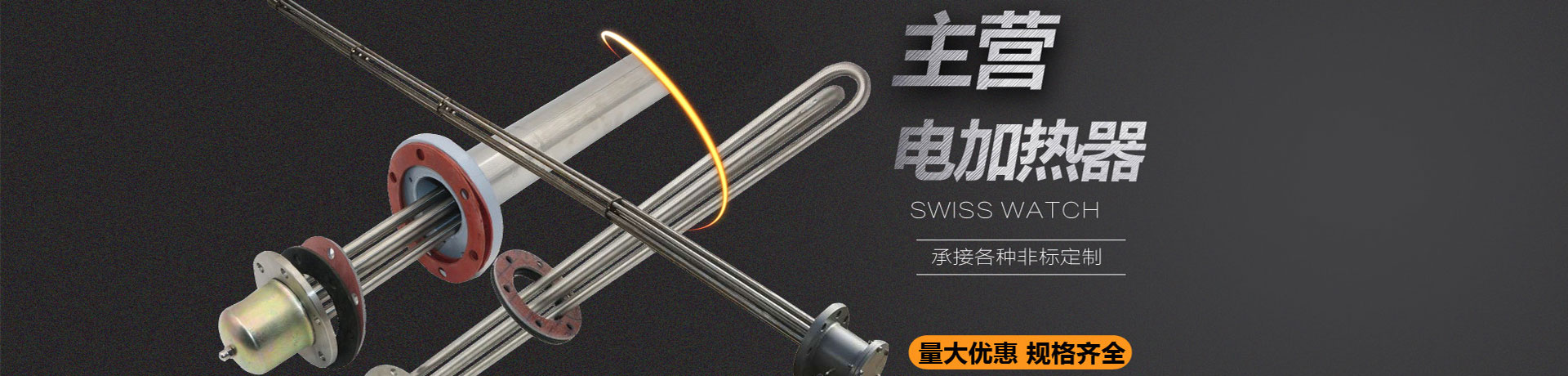

HRY, SRY TypeTubular Electric Heater
1. Usage
SRY2 and SRY3 tubular electric heaters are used for heating oil in open or closed oil tanks. SRY4 tubular electric heater is used for heating flowing or circulating oil.
2. Specifications and Technical Data
1. Specifications and dimensions: see table and figure below
Note: The mounting hole for SRY2 and SRY4 types is Ø72 mm.
2. Working voltage tolerance: not greater than 1.1 times the rated value, and the shell must be effectively grounded.
3. Working environment: relative humidity not greater than 95%, no explosive or corrosive gases.
4. Metal tube material: No. 10 steel.
5. Maximum working temperature: SRY2 and SRY3 are 300°C, SRY4 is 100°C.
6. Working pressure for SRY2 and SRY4 types is less than 2 kg/cm².
7. The length of the fastener for SRY3 type is 25 mm.
3. Usage, Maintenance, and Precautions
1. Dimension "B" in the dimension drawing must be fully immersed in oil to avoid burning out the element. The heated oil should be non-corrosive.
2. The working liquid level for SRY3 type must be below the fastener and above the dimension line "B".
3. When melting solid oils such as asphalt and paraffin, reduce the voltage during use, and then raise to the rated voltage after melting, to prevent heat concentration and reduce the service life of the element.
4. If carbon deposits are found on the tube surface, they must be removed before reuse to avoid reducing efficiency or even burning out the element.
5. The element should be stored in a dry place. If the insulation resistance drops below 1 megohm due to long-term storage, it can be dried in an oven at about 200°C for several hours (or powered at low voltage for several hours) to restore the insulation resistance.
|
Model FL2 |
Voltage (V) |
Power (kW) |
Dimensions (mm) |
Weight (kg) |
||
|
A |
B (immersed length) |
C |
||||
|
SRY2-220/1 |
220 |
1 |
307 |
230 |
" |
1.45 |
|
SRY2-220/2 |
220 |
2 |
507 |
430 |
" |
1.90 |
|
SRY2-220/3 |
220 |
3 |
707 |
630 |
" |
2.35 |
|
SRY2-220/4 |
220 |
4 |
922 |
845 |
" |
2.83 |
|
SRY3-220/1 |
220 |
1 |
625 |
375 |
570 |
0.77 |
|
SRY3-220/2 |
220 |
2 |
825 |
575 |
770 |
1.01 |
|
SRY3-220/3 |
220 |
3 |
925 |
675 |
870 |
1.13 |
|
SRY3-220/4 |
220 |
4 |
1125 |
875 |
1070 |
1.37 |
|
SRY4-220/5 |
220 |
5 |
697 |
620 |
" |
2.45 |
|
SRY4-220/6 |
220 |
6 |
807 |
730 |
" |
2.70 |
|
SRY4-220/8 |
220 |
8 |
1007 |
930 |
" |
3.05 |
HRY, SRY TypeTubular Electric Heater
The tubular electric heater consists of a metal tube, spiral resistance wire, and electrical-grade magnesium oxide powder with good thermal conductivity and insulation, as well as lead terminals. It is widely used for heating liquids, air, etc. Common applications include water heaters, ovens, coffee pots, etc.
Materials:
Common materials for the outer tube include In800, In840, 304, 316L, 310S, aluminum, copper, low-carbon steel, etc.
Magnesium oxide powder is selected in different specifications according to different usage requirements, such as high-temperature powder, medium-temperature powder, etc.
The resistance wire is the heating element, and there are generally two types of materials: Ni-Cr wire and Fe-Cr-Al wire.
Lead terminal materials generally include two types: stainless steel and free-cutting iron.
Sealing materials include epoxy, silicone, glass, etc.
Process:
The heating tube is made by inserting the heating wire into the outer tube (carbon steel tube, titanium tube, stainless steel tube, copper tube), filling the gaps with magnesium oxide powder that has good thermal conductivity and insulation, and then shrinking the tube. After heat treatment (some tubes do not require it), it is processed into various shapes required by the user. It has the advantages of simple structure, high thermal efficiency, good mechanical strength, and good adaptability to harsh environments. It can be used for heating various liquids and acid, alkali, and salt solutions, and is also suitable for melting low-melting-point metals.
Applications of tubular heaters: suitable for heating air, oil, water, chemical media, hot pressing molds, melting salts, alkalis, and low-melting-point alloys, etc. It features high thermal efficiency, long service life, high mechanical strength, easy installation, safety, and reliability.
Classification of tubular heaters by shape: According to different shapes, heating tubes can be classified into straight single-end heating tubes, straight double-end heating tubes, U-shaped heating tubes, W-shaped heating tubes, special-shaped heating tubes, and spiral heating tubes.