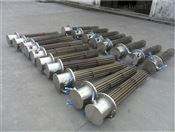

SRY4-220/5 Tubular Electric Heater
1. The element is allowed to work under the following conditions: A. The relative humidity of air is not greater than 95%, without explosive and corrosive gases. B. The working voltage should not exceed 1.1 times the rated value, and the shell should be effectively grounded. C. Insulation resistance ≥1MΩ Dielectric strength: 2KV/1min.
2. The electric heating tube should be properly positioned and fixed. The effective heating zone must be fully immersed in liquid or solid metal. Dry burning is strictly prohibited. If scale or carbon deposits are found on the surface of the tube, they should be cleaned promptly before reuse to avoid affecting heat dissipation and shortening the service life.
3. When heating fusible metals or solid nitrates, alkalis, asphalt, paraffin, etc., the operating voltage should be reduced first, and only after the medium melts can it be raised to the rated voltage.
4. When heating air, the elements should be arranged crosswise and evenly to ensure good heat dissipation conditions and fully heat the passing air.
5. When heating nitrate salts, safety measures should be considered to prevent explosion accidents.
6. The wiring part should be placed outside the insulation layer to avoid contact with corrosive, explosive media, and moisture. The lead wires should be able to withstand the temperature of the wiring part and the heating load for a long time. When tightening the wiring screws, avoid excessive force.
7. The elements should be stored in a dry place. If the insulation resistance drops below 1MΩ due to long-term storage, they can be dried in an oven at about 200°C or heated by applying reduced voltage until the insulation resistance is restored.
8. The magnesium oxide powder at the outlet end of the electric heating tube should be protected from pollutants and moisture infiltration at the place of use to prevent leakage accidents.
SRY4-220/5 Tubular Electric Heater
In the production process of electric heating tubes, blackening treatment is sometimes used. Blackening treatment is a process in the heat treatment of stainless steel and other metal objects. After treatment, a layer of oxide film is formed on the surface to achieve the purpose of anti-corrosion and rust prevention. After the blackening treatment, the wear resistance of the heating tube surface is improved, and the surface hardness is increased, without affecting the internal components of the electric heating tube.
Under normal working conditions, the simplest method for blackening the surface of electric heating tubes involves the following steps:
1. First, clean the surface of the metal tube to keep it clean;
2. Second, perform degreasing treatment on the surface. This process can be done by completely placing the metal tube in a degreasing solution. The pH value of the degreasing solution is about 13, and the time should not be less than half an hour. After degreasing, rinse with clean water.
3. Next, pickling can be carried out. The pH value of the pickling solution is about 3, and the treatment time should not exceed 10 minutes. After pickling, rinse with clean water;
4. Blackening treatment: The concentration of the bath solution has a pH value between 2-4, and the treatment time is about 10 minutes. After blackening, it must be cleaned thoroughly;
5. Finally, dry and oil;
Following the above five points, blackening treatment of electric heating tubes is a very effective method.
The typical structure of a metal tubular electric heating tube (the most common structure) generally consists of 5 parts: insulator, sealing material, lead-out rod, filling material, heating wire, metal protective sleeve, and terminal.
The spiral heating wire and the lead-out rod are located in the center of the metal protective sleeve. The manufacturing process involves threading the spiral heating wire into a seamless steel tube, copper tube, or aluminum tube, and uniformly filling the gaps with an insulating and thermally conductive oxide medium, such as crystalline magnesium oxide powder (or alumina or clean quartz sand, etc.) using a multi-tube filling machine. Then, a tube shrinking machine is used to reduce the tube diameter, making the oxide medium dense (density above 3.3g/cm3), ensuring that the heating wire is isolated from air and the center position does not shift to touch the tube wall. In this way, the heat generation per unit area can be increased by more than ten times. The service life can also be correspondingly increased to more than 10 years. Compared with electric heating elements with the same large heat output, tubular electric heating tubes can save 5% of heating materials, and the thermal efficiency can reach more than 90%.
Therefore, from the structure of electric heating tubes, metal tubular electric heating tubes are currently the most widely used, simple in structure, reliable in performance, and long in service life. They are sealed electric heating elements that can be successfully applied in industry and household appliances, and their use is becoming more and more widespread. It is hoped that more users will have a clear understanding of the structural principles of electric heating tubes.
Common Types
Fin Electric Heating Tube
A fin electric heating tube is a type that converts electrical energy into heat energy to heat the material to be heated. During operation, the low-temperature fluid medium enters the input port through the pipeline under pressure, follows the specific heat exchange flow path inside the electric heating container, and uses the path designed based on fluid thermodynamics principles to take away the high-temperature heat energy generated during the operation of the electric heating element, raising the temperature of the heated medium. The fin electric heating tube outlet obtains the high-temperature medium required by the process. The finned tubular electric heating element is made by winding metal heat dissipation fins on the surface of a common element. Compared with common elements, the heat dissipation area is expanded by 2 to 3 times, meaning the allowable surface power load of the fin element is 3 to 4 times that of a common element. Since the length of the element is shortened, its own heat loss is reduced. Under the same power conditions, it has the advantages of fast heating, high thermal efficiency, long service life, small heating device volume, and low cost. It can be installed in air duct pipelines or other heating occasions for static or flowing air.
Flange Electric Heating Tube
A flange electric heating tube (also called an insertion-type electric heater) uses U-shaped tubular electric heating elements. According to the design specifications for heating different media and the power configuration requirements, they are assembled on the flange cover and inserted into the material to be heated. The large amount of heat generated by the heating element during operation is conducted to the heated medium, raising the medium temperature to meet the required process requirements. When the medium temperature reaches the set value required by the process, the control system adjusts the output power of the electric heater based on the temperature sensor signal after PID calculation, achieving temperature control of the resistive load of the heating element. This makes the medium temperature uniform and meets the requirements. When the heating element overheats or the liquid level is low, the interlock protection device of the heating element immediately cuts off the heating power to avoid burning out the heating element and extend its service life. Flange electric heating tubes are mainly used for heat preservation and heating of materials in various storage tanks, containers, and oil tanks in industries such as petroleum, chemical, food, and machinery. The connection method can be flange type or threaded end face sealing.
Titanium Electric Heating Tube
A titanium electric heating tube uses a titanium tube as the shell, with electric heating alloy wires uniformly distributed along the central axis inside the tube. The gaps are filled and compacted with magnesium oxide sand that has good insulation and thermal conductivity. The tube ends are sealed with silicone or ceramics. This metal electric heating element is specially designed for highly corrosive liquids. Titanium electric heating tubes have the characteristics of simple structure, high mechanical strength, high thermal efficiency, safety and reliability, easy installation, and long service life. They are widely applicable to various highly corrosive liquids. Titanium material has a small specific gravity and is widely used for heating water, nitrate solutions, acid solutions, and alkali solutions. Practice has proven that titanium has high efficiency and long life in anti-corrosion equipment production applications, and in electroplating equipment applications, it does not affect the plating solution and can greatly improve the efficiency of the electroplating industry. The effective length of the electric heating element must be fully immersed in the liquid for use.
Teflon
A Teflon electric heating tube is a new type of electric heating tube that is resistant to strong corrosion and is used for heating various corrosive liquids. It has excellent aging resistance and good flexibility, and adopts a low surface load design. The joints are fully sealed and acid-alkali resistant. The non-heating section and over-temperature safety protection system are customized according to customer requirements. It fully ensures that the heater is not easy to burn out, has a long service life, is fully sealed, non-toxic, leak-proof, with grounding protection, and is safe and reliable. The applicable temperature is below 110°C. Anti-corrosion Teflon electric heating tubes have the advantages of high thermal efficiency, energy saving, and high cost performance. They can be designed in various structural forms, such as spiral, L-shaped, U-shaped, W-shaped, mosquito coil type, and combined type. They have been recognized by many listed companies and serve as long-term suppliers of mosquito coil type Teflon electric heaters. We can undertake non-standard products. In terms of voltage, power, specification size, product shape, and wiring method, engineers can design according to customer needs. We welcome drawings and samples for custom production.
Quartz Electric Heating Tube
Quartz heating tubes, the most commonly used are carbon fiber quartz heating tubes.
Carbon fiber heating tubes, also known as carbon fiber electric heating tubes, infrared heating tubes, infrared electric heating tubes, carbon fiber infrared electric heating tubes, carbon fiber infrared heating tubes, etc. They consist of a carbon fiber filament placed in a quartz tube, which is vacuum-sealed. Voltage is applied to the carbon fiber filament to generate heat. Our company's products use imported carbon fiber heating elements, which have the advantages of large power margin, high temperature resistance, strong heating capability, long service life, and adjustable power.
Radiant Electric Heating Tube
A radiant heating tube encloses the electric heating element in a protective sleeve and generates heat when energized. The sleeve indirectly radiates heat to the furnace lining and the workpiece being processed. It is widely used in various heating furnaces in the heat treatment industry. The electric heating alloy material used in radiant heating tubes should have high resistivity and high electrothermal conversion efficiency. Since the radiant tube is placed inside the sleeve, the heat transfer process is different from that of ordinary exposed heating elements. It has large heat shielding, and the element temperature must be controlled during the heating process to prevent overheating. When the radiant tube is heated in a closed manner, the surface temperature of the electric heating element is about 100°C-150°C higher than the furnace temperature. Therefore, when selecting materials, it is necessary to analyze the furnace temperature and the atmosphere inside the furnace to choose the correct heating material.