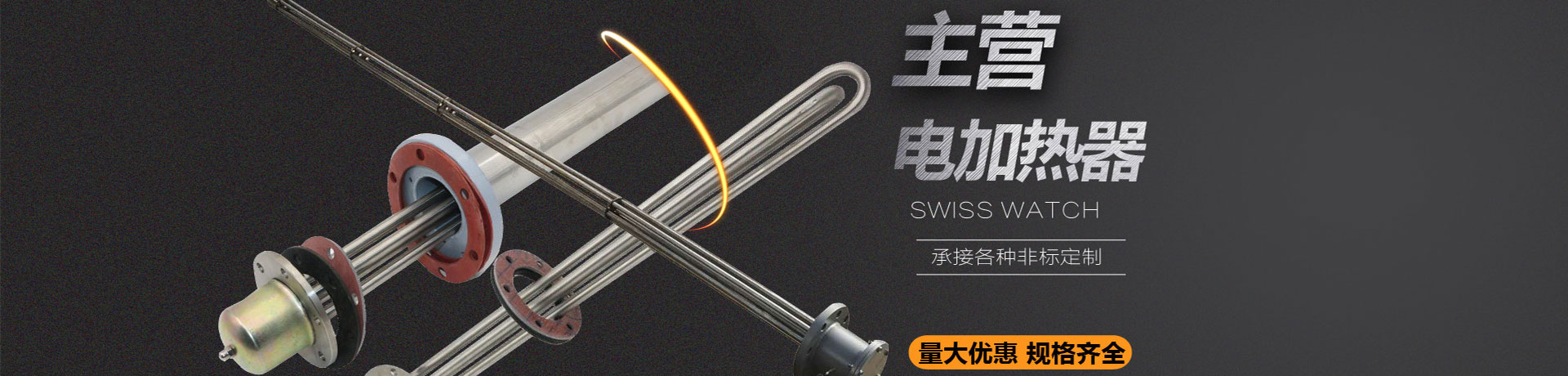
When purchasing a sheathed electric heater, how can you determine whether a product will fit into your existing equipment without causing the heating core wire to fail prematurely? The following explains this point by point based on application scenarios.
A sheathed electric heater completely encloses the resistance heating core wire within a metal sheath, with an insulating and thermally conductive medium filled and compacted between the core wire and the sheath, and the ends sealed. The sheath material can be selected according to the medium environment, commonly stainless steel, carbon steel, etc.; the tube diameter, bending radius, and lead-out method are all determined at the time of ordering. The structural closure allows the element to be used for contact heating of liquids, air, and metal surfaces.
The rated voltage is typically single-phase 220V or three-phase 380V, and should be selected according to the on-site power supply and wiring method. The surface heating power must be controlled in conjunction with the medium and flow rate; a higher load will shorten the service life of the element, while a lower load will extend the heating time. During selection, the medium name, operating temperature, container volume or flow rate should also be provided to facilitate calculation of the total power.
Sheathed electric heaters are widely used in boilers, chemical engineering, shipbuilding, power construction, machinery, and other sectors, for pre-weld heating, post-weld intermediate hydrogen removal, and annealing heat treatment of alloy steel structural parts, pipelines, and pressure vessels; they are also commonly used for heating heat transfer oil, water, and various process bath liquids, as well as pipeline tracing and localized heat treatment stations. Different scenarios have significantly different requirements for sheath material, lead wire temperature resistance grade, and installation and fixation methods.
Before placing an order, it is recommended to confirm: whether the installation hole positions and insertion depth match; whether the sheath material is compatible with the contact medium; whether the rated voltage is consistent with the on-site power supply; whether the lead wire length and terminal box position facilitate construction; and whether supporting temperature control and overheating protection are required. Complete information as above can reduce rework after delivery.