Tubular Heater
Tubular Heater / Sheathed Heating Element is the most common and widely used resistive electric heating device, extensively used for heating various media such as liquids and air.
A tubular heater is composed of a metal sheath, resistance heating wire, magnesium oxide powder filler, sealing material, lead rods, etc., adopting a "core wire–insulation–sheath" coaxial structure.
Metal sheath: Materials include 304/316L/310S stainless steel, Incoloy 800/840, copper, aluminum, low carbon steel, titanium tube, etc. Tube diameter is typically φ6–φ30mm
Resistance heating wire: Located at the center of the tube, uniformly distributed in a spiral shape, made of nickel-chromium alloy wire (Cr20Ni80, temperature resistance 1400°C) or iron-chromium-aluminum alloy wire (0Cr25Al5, temperature resistance 1200°C)
Insulation filler: Crystalline magnesium oxide powder (MgO), combining high temperature resistance (above 1000°C), high insulation (breakdown voltage ≥500V), and high thermal conductivity (thermal conductivity ≥3.5W/m·K). After tube reduction process compaction, density reaches above 3.3g/cm³
Lead rod/terminal: Made of stainless steel or free-cutting iron, surface nickel-plated for oxidation resistance
Sealing material: Both ends of the tube are sealed with silicone, ceramic adhesive, or glass to prevent moisture ingress
Based on Joule's law—when current passes through the spiral resistance wire inside the tube, heat is generated. The heat is conducted through the filled magnesium oxide powder to the metal sheath surface, and then heats the external medium (air, liquid, or metal mold) through conduction, radiation, or convection. The heating wire does not directly contact the outside, and the surface is not electrified, providing good safety.
According to different shapes, tubular heaters can be classified as:
Table
Download as table
Export as image
Type Features Typical Applications
Straight single-end heating tube Single-end wiring, compact structure Water heaters, water dispensers
Straight double-end heating tube Double-end wiring, higher power Industrial water tanks, oil tanks
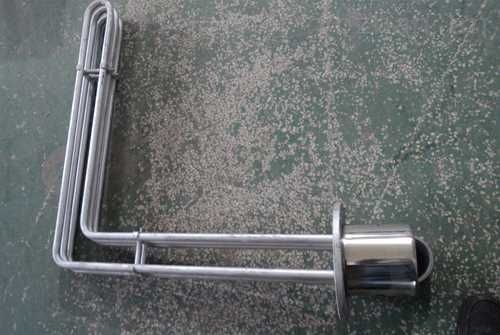
U-shaped heating tube Bent into U shape, increased heating area Ovens, boilers
W-shaped heating tube Multiple bends, suitable for narrow spaces Enclosed container heating
Spiral heating tube Spiral winding, uniform heat dissipation Shower heaters, dishwashers
Special-shaped heating tube Customized shapes as needed Molds, special equipment
By lead-out method, they can also be divided into: standard double-end lead-out (Type A), single-end parallel lead-out (Type C), single-end coaxial lead-out (Type D), and embedded components, etc.
High thermal efficiency: Electric-to-heat conversion efficiency can reach ≥98%
High mechanical strength: Metal shell is sturdy and durable, can withstand certain pressure
Uniform heating: Heat is evenly distributed along the tube length, avoiding local overheating
Safe and reliable: Surface is not electrified, good insulation performance
Long service life: Can reach tens of thousands of hours with proper use
Easy installation: Supports threaded, flange, welding, and other installation methods
Strong adaptability: Can be used for heating liquid, gas, and solid media
Tubular heaters have extremely wide applications:
Home appliances: Water heaters, ovens, coffee makers, water dispensers, dishwashers
Industrial equipment: Hydraulic oil/lubricating oil heating, thermal oil boilers, reactor heating
Food processing: Fryers, pasteurization equipment, cooking equipment
Chemical industry: Acid, alkali, and salt solution heating, chemical medium preheating
Plastic processing: Injection molding machine barrel heating, mold heating (PE about 200°C, PEEK over 300°C)
Energy and environmental protection: Natural gas pressure reducing station heat tracing, pipeline freeze protection, boiler make-up water heating
Metal processing: Low melting point alloy melting, aluminum extrusion die heating
JB/T 2379-2016 "Metal Tubular Heating Elements" Industrial tubular heating elements with working voltage ≤440V
NB/T 10309-2019 "Anti-corrosion Metal Tubular Heating Elements" Elements working in corrosive media, rated voltage ≤480V
GB/T 23150-2024 "Tubular Heaters for Water Heaters" Elements for household and similar water heaters
JB/T 4088 series Daily-use tubular heating elements For daily-use electrical appliances
Dry burning strictly prohibited: The heating section must be fully immersed in the medium, otherwise heat cannot dissipate and will cause burnout
Surface power density must match the medium: Water heating generally 5–10W/cm², oil 1–3W/cm², air heating 1–2W/cm² (fins required)
Material must match corrosiveness: For weak corrosion choose 316L stainless steel, for strong corrosion choose titanium tube or Incoloy alloy
When melting solid oils (such as asphalt, paraffin), first use at reduced voltage, then increase to rated voltage after melting, to prevent heat concentration and reduced lifespan
Regular maintenance: Remove carbon deposits and scale from the tube surface. If insulation resistance is below 1 megohm after long-term storage, dry in a 200°C oven for several hours to restore insulation
High temperature environment: When the element surface temperature exceeds 450°C, brass lead rods are prohibited (zinc will volatilize)
🔗 Difference from sheathed electric heaters
Tubular heaters are the basic structural form, while sheathed electric heaters (such as the HRY series) add an outer sheath structure on the basis of tubular heaters, isolating the heating core from the medium. The advantage of the sheathed type is that the medium does not need to be drained when replacing the core, making maintenance more convenient, suitable for continuous production occasions with high reliability requirements; ordinary tubular heaters have a simple structure and lower cost, suitable for general heating scenarios.