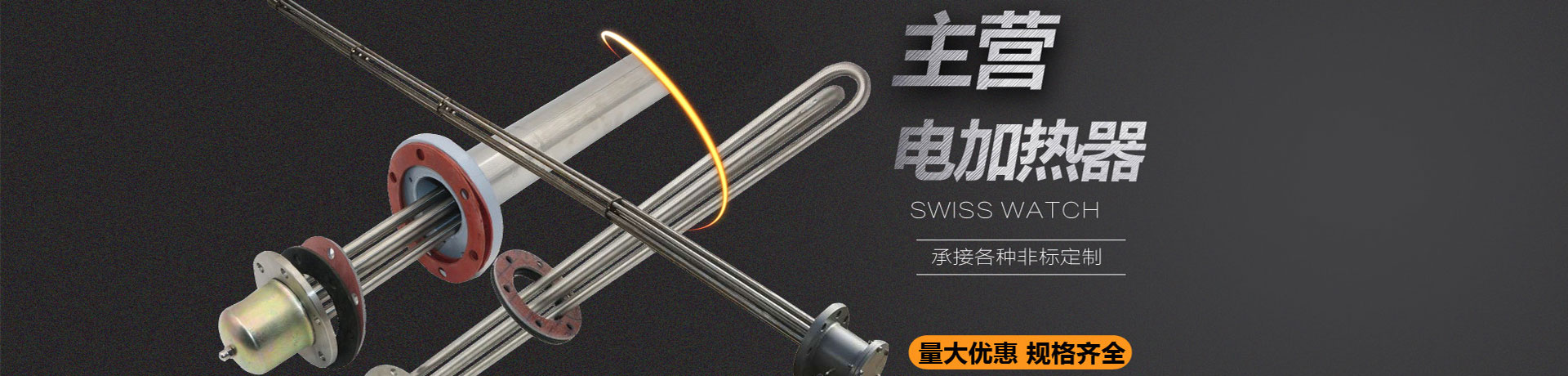
Tubular Electric Heater
A tubular electric heater (Tubular Heater / Sheathed Heating Element) is a resistive electric heating device that uses a metal tube as its outer shell, with a resistance heating wire placed inside and filled with an insulating and thermally conductive medium. It is one of the most common and widely used electric heating elements today.
Working Principle
Based on Joule's law, when current passes through the spiral resistance wire inside the tube, heat is generated. The heat is conducted through the filled crystalline magnesium oxide powder (MgO) to the surface of the metal tube shell, and then heats the external medium (air, liquid, or metal mold) through conduction, radiation, or convection. The entire process leaves the surface uncharged, making it safe and reliable.
Core Structure
The tubular electric heater consists of the following parts:
Metal sheath tube: serves as the outer shell, providing mechanical support, corrosion protection, and heat transfer. The tube diameter is usually φ6-30mm.
Resistance heating wire: a spiral resistance wire located at the center of the tube and evenly distributed along the axial direction.
Insulating filler: crystalline magnesium oxide powder (MgO), which combines high temperature resistance (above 1000°C), high insulation (breakdown voltage ≥500V), and high thermal conductivity (thermal conductivity ≥3.5W/m·K). After being compacted by the tube reduction process, its density reaches above 3.3g/cm³.
Lead rod/terminal: the conductive component connecting the heating wire to the external power supply.
Sealing material: both ends of the tube opening are sealed with silicone, ceramic adhesive, or silicone rubber to prevent moisture intrusion.
Insulator: used to fix and insulate the lead rod.
Main Material Selection
Table
Download as Table
Export as Image
Component Optional Materials
Sheath tube In800, In840, 304, 316L, 310S stainless steel, aluminum, copper, low carbon steel, titanium tube
Heating wire Nickel-chromium alloy wire (Ni-Cr, temperature resistance 1400°C), iron-chromium-aluminum alloy wire (Fe-Cr-Al, temperature resistance 1200°C)
Magnesium oxide powder Low-temperature type (below 400°C), medium-temperature type (400-600°C), high-temperature type (600-850°C)
Lead rod Stainless steel, free-cutting iron (brass is prohibited when surface temperature exceeds 450°C to prevent zinc volatilization)
Sealing material Epoxy, silicone, glass
Shape Classification
According to different shapes, they can be divided into:
Straight single-end heating tube: single-end lead wire, suitable for closed containers
Straight double-end heating tube: lead wires at both ends, the most commonly used structure
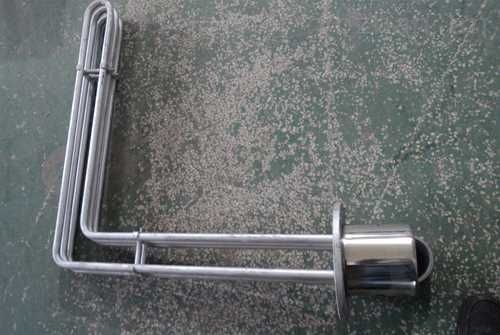
U-shaped heating tube: bent into a U shape, increasing heat generation per unit area
W-shaped heating tube: multi-bend structure, suitable for large-area heating
Spiral heating tube: coiled into a spiral shape, suitable for water tanks, oil tanks, etc.
Special-shaped heating tube: various shapes customized according to user needs
According to the lead-out method, they can also be divided into: standard type with leads at both ends (Type A), single-end parallel lead-out (Type C), single-end coaxial lead-out (Type D), and embedded components, etc.
Key Technical Parameters
Table
Download as Table
Export as Image
Parameter Typical Range
Operating voltage Not exceeding 440V (industrial type can reach 380V/three-phase)
Electrothermal conversion efficiency ≥98%
Surface load 1.2-3.8 W/cm²
Maximum operating temperature Gas medium can reach 850-1050°C, liquid medium 0-350°C
Operating pressure Standard 1.0-8MPa, high-pressure customization can reach 10-20MPa
Temperature control accuracy ≤±0.8°C-±1°C
Insulation resistance ≥1MΩ
Dielectric strength 2KV/1min
Core Features
High thermal efficiency: electrothermal conversion efficiency can reach over 98%, and almost all heat is transferred to the heating medium
High mechanical strength: the metal sheath tube provides good protection, corrosion resistance, and wear resistance
Uniform heating: the spiral resistance wire is evenly distributed, resulting in good surface temperature consistency
Safe and reliable: the surface is uncharged and equipped with an overheating protection structure
Long service life: low designed surface power load reduces element aging
Convenient installation and maintenance: flange connection or threaded connection, supporting modular installation and quick disassembly
Strong adaptability: can be designed as explosion-proof type (Ex db IIC T1-T6 Gb), anti-corrosion type, and various other special models
Application Fields
Industrial heating: heating of oil, water, and chemical media in storage tanks, reactors, and hot-pressing molds
Air heating: drying ovens, drying tunnels, duct-type heaters
Liquid heating: water tanks, oil tanks, acid-base tanks, heat transfer oil systems
Metal melting: melting and heating of low-melting-point alloys, salts, and alkalis
Food processing: continuous fryers (160-190°C), pasteurization equipment (precise temperature control at 72°C)
Plastic processing: zoned heating of extruder barrels and molds (above 200-300°C)
Energy systems: boiler modification, pipeline heat tracing and freeze protection, solar pipeline insulation
Household appliances: water heaters, ovens, coffee makers, water dispensers, dishwashers, etc.
Related Standards
JB/T 2379-2016 "Metal Tubular Electric Heating Elements": core industry standard, applicable to industrial tubular electric heating elements with operating voltage not exceeding 440V
NB/T 10309-2019 "Anti-corrosion Metal Tubular Electric Heating Elements": applicable to elements working in corrosive media
GB/T 23150-2024 "Tubular Heaters for Water Heaters": implemented from April 1, 2025, applicable to household water heaters
GB/T 8623-1988 "Metal Tubular Far-Infrared Radiation Heaters": far-infrared radiation type
CB/T 3869-1999: Technical conditions for tubular electric heaters used in marine oily water separation devices
Usage Precautions
Dry burning is strictly prohibited: the effective heating area must be fully immersed in liquid or solid metal
Scale treatment: when there is scale or carbon deposit on the tube surface, it must be cleaned thoroughly before use; otherwise, heat dissipation will be affected and service life shortened
Low-melting-point media: when heating solid media such as asphalt and paraffin, the voltage should be reduced first, and then raised to the rated voltage after melting
Air heating: elements should be arranged crosswise and evenly to ensure good heat dissipation conditions
Moisture and contamination prevention: the magnesium oxide powder at the lead end should be protected from moisture and contaminants to prevent leakage
Storage requirements: should be stored in a dry place; if the insulation resistance is lower than 1MΩ after long-term storage, it can be restored by drying in a 200°C oven for several hours or by energizing at low voltage
Wiring safety: the wiring part should be placed outside the insulation layer to avoid contact with corrosive, explosive media and moisture