Tubular Electric Heaters
Analysis completed, with reference to 17 sources
Tubular electric heaters are the most basic and most widely used heating elements in industrial production lines, found everywhere from injection molding machine barrels to heat transfer oil systems, from water tank heating to mold temperature control. But precisely because they are "too common," it is easiest to make mistakes during selection—incorrect surface load calculations, wrong material choices, or installation dimensions off by a few millimeters can lead to sharply reduced service life in mild cases, or leakage and shutdown in severe cases.
Combined with Yangzhou's local industrial supporting capabilities, here is a practical selection and procurement guide for you:
I. Mainstream Tubular Heater Types and Selection Comparison
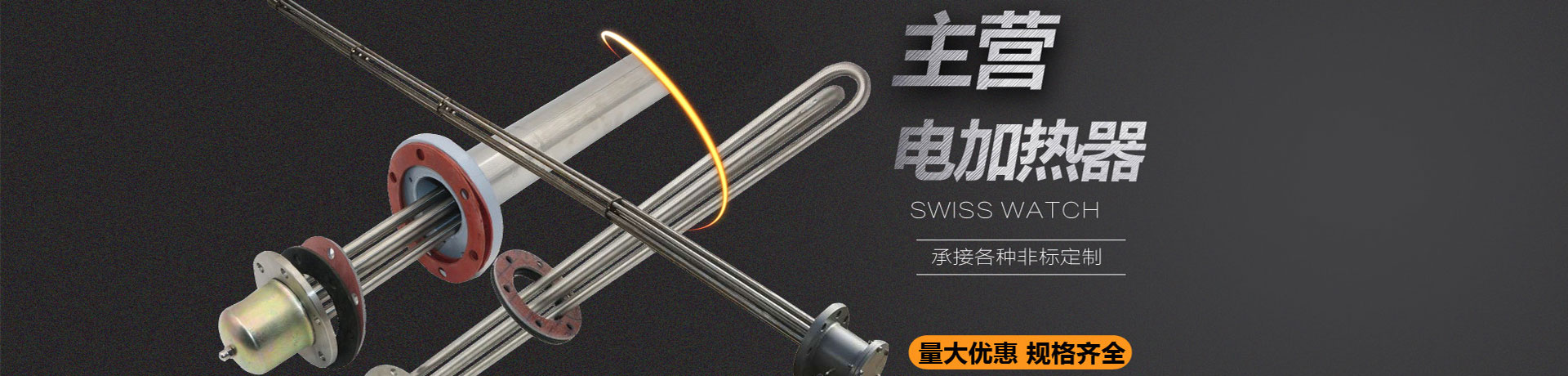
Tubular electric heaters are mainly divided into the following categories by structure and application scenario:
Table
Download as Table
Export as Image
Type Typical Structure Surface Load Reference Applicable Scenario Key Precautions
SRY2 Type Straight tube immersion type 2~4 W/cm² Open/closed oil tanks, hydraulic oil, lubricating oil heating Immersion length B must be 100% immersed in oil, maximum working temperature 300℃
SRY3 Type Straight tube immersion type (slim type) 2~4 W/cm² Deep oil tanks, narrow-space oil tank heating Same temperature range as SRY2, but thinner tube diameter and longer length
SRY4 Type Direct heating type 2~4 W/cm² Flowing or circulating oil heating Maximum working temperature only 100℃, not suitable for high-temperature conditions
Single-head Heating Tube Single-end lead-out 6~8 W/cm² (conventional) Injection molds, hot runners, narrow deep holes Customizable high power density type (up to 60 W/cm²)
Flange-type Heating Tube Flange fixing Determined by medium Pressure vessels, reactors, steam generators High sealing requirements, must match flange standards (GB/HG/JIS)
Threaded Heating Tube Threaded connection 1~4 W/cm² Small oil temperature machines, pipeline heating Convenient installation, suitable for frequent maintenance scenarios
Finned Heating Tube With heat dissipation fins 3~5 W/cm² Air heating, air duct heating Fins increase heat dissipation area, better forced convection effect
II. Core Selection Parameters: 5 Hard Indicators That Must Be Checked
1. Surface Load (W/cm²)—The Decisive Factor for Service Life
Surface load = Power (W) ÷ Heating zone surface area (cm²), and it is the most easily overlooked yet most critical parameter in selection. Recommended values vary greatly for different media:
Clean water/drinking water: 6~8 W/cm²
Oil/heat transfer oil: 2~4 W/cm²
Heavy oil/asphalt: 1~2 W/cm²
Corrosive liquids (acid/alkali): 3~5 W/cm²
Static air: 1~3 W/cm²
Flowing air: 3~5 W/cm²
Mold/metal solids: 5~15 W/cm²
Pitfall reminder: In heat transfer oil conditions, if the surface load exceeds 0.7 W/cm², local overheating will cause oil carbonization to adhere to the tube wall, sharply reducing heat transfer efficiency or even burning out the element. During procurement, be sure to have the manufacturer calculate the actual W/cm² value, rather than only looking at power.
2. Sheath Material—Determines Corrosion Resistance and Temperature Resistance
304 stainless steel: clean water, food-grade media, ordinary oils (may pit when chloride ions >200ppm)
316L stainless steel: seawater, chemical corrosive environments, acid-alkali media
310S/Incoloy 800: high-temperature conditions (>300℃), molten salt heating
Titanium alloy: strongly corrosive solutions, electroplating baths
Teflon (PTFE) coating: strong acids and alkalis, scenarios requiring anti-sticking
Pitfall reminder: Some manufacturers use 304 uniformly to reduce costs, and in corrosive conditions it perforates and leaks within 3~6 months. Be sure to clearly inform them of the medium composition and require material test reports.
3. Voltage and Power Matching
Single-phase 220V: single unit power ≤3kW, suitable for small equipment
Three-phase 380V: single unit power ≤30kW, general industrial use
Special voltage: 12V/24V DC, 440V, etc. can be customized
Power calculation reference formula:
Liquid heating power: P(kW) = medium mass flow rate(kg/h) × specific heat capacity(kJ/kg·℃) × temperature difference(℃) ÷ 3600 ÷ thermal efficiency(0.9~0.95)
Safety margin: conventional systems reserve 10%~20%, continuous operation or low-temperature environments reserve 20%~30%
4. Installation Dimensions and Structural Form
Tube diameter: common φ8~φ50mm, single-head tubes for molds can be as small as φ3.7mm
Length: standard products 20~2000mm, non-standard can be customized up to 6 meters
Mounting hole: SRY2/SRY4 type mounting hole φ72mm; SRY6/HRY series protective sleeve tube φ108mm, mounting hole must be ≥φ114mm
Pitfall reminder: Nominal dimensions often deviate from actual by ±1~2mm. Before procurement, be sure to confirm the measured value to avoid buying something that cannot be installed.
5. Protection and Explosion-Proof Rating
Ordinary environment: IP54 is sufficient
Outdoor/humid: IP65 and above
Flammable and explosive environments: must use flameproof type, explosion-proof rating ExdⅡCT4 and above, and obtain an explosion-proof certificate
III. Recommended High-Quality Local Manufacturers in Yangzhou
Baoying County, Yangzhou is a core production area for electric heating tubes in China, with a mature industrial chain and complete supporting facilities:
Specializes in producing SRY2 type tubular electric heaters for open or closed oil tank heating, with a product line covering conventional oil tank heating scenarios.
Founded in 2005, products cover electric heating tubes, electric heaters, explosion-proof electric heaters and temperature control equipment, and also sells high-voltage testing instruments, with "heating + testing" supporting capabilities.
: Located in Baoying Chengnan Industrial Concentration Zone, focusing on R&D and processing of electric heaters, heating tubes, and boiler heating tubes, holding 3 patents, suitable for non-standard customization needs.
: Product line covers electric heating tubes, crawler-type heaters, bolt heating rods, thermocouples and temperature control equipment, supporting complete set supply.
: Founded in 2005, equipped with CNC winding machines and automatic powder filling machines, quick response and short delivery time for small and medium batch customization, suitable for prototyping and rush orders.
: Founded in 2000, mainly engaged in infrared heating tubes, electric heating tubes, and thermocouples, products exported to Japan, South Korea, Europe and America, annual production capacity of 1 million industrial heating tubes, suitable for customers with export quality requirements.
IV. Daily Maintenance and Troubleshooting
Fault Phenomenon Possible Cause Handling Method
No heating/slow heating Power supply phase loss, heating tube burned out, medium not flowing Measure resistance (infinite means open circuit), check air switch/contactor, confirm pump valve is open
Leakage tripping Insulation damp/broken down, junction box water ingress, dry-burn damage Use megohmmeter to measure insulation (<0.5MΩ needs replacement), dry the junction box, check grounding
Three-phase current imbalance Resistance drift of a certain heating tube, loose wiring Measure resistance of each phase separately, deviation >±10% is abnormal, tighten terminals
Reduced thermal efficiency Scaling/carbon buildup on tube wall, insufficient medium flow Disassemble for descaling/acid cleaning, verify pump head and whether pipeline is blocked
Flange leakage Aging gasket, bolts not evenly tightened Replace temperature- and pressure-resistant gasket, tighten diagonally in steps
Recommended maintenance cycle:
Every 6~12 months, use a 500V megohmmeter to measure insulation resistance; if below 1MΩ, dry or replace
In hard water scenarios, disassemble and inspect for descaling every 2 months
Before restarting after each long shutdown, measure insulation resistance to confirm normal