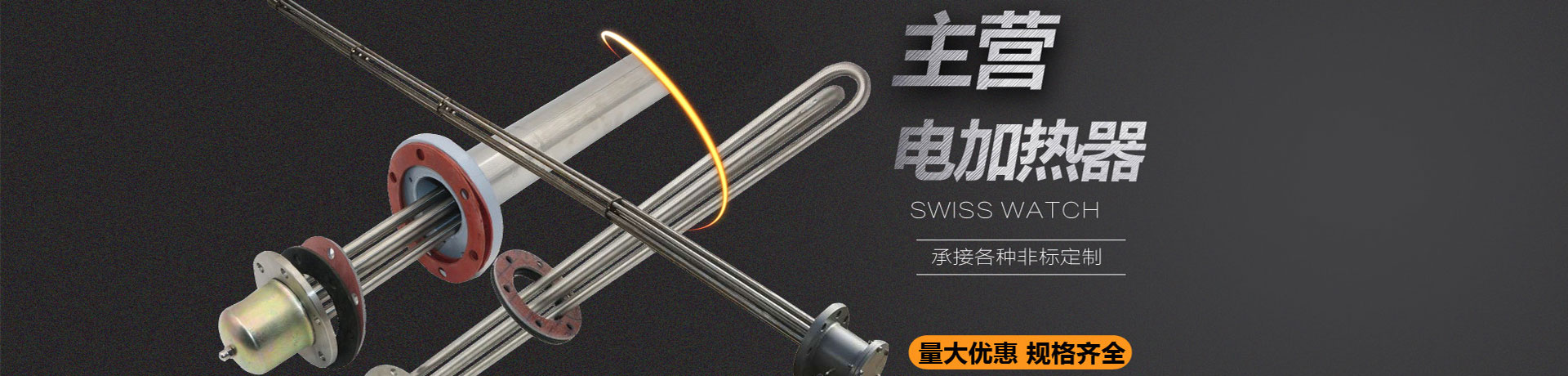
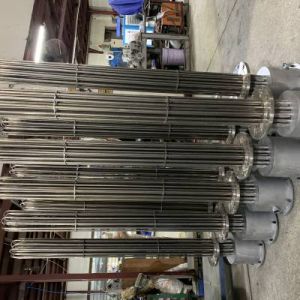
Tubular Electric Heaters
Tubular electric heaters (commonly known as heating tubes) are the most fundamental heating elements in the industrial heating field, and are also the core component of the "sheathed electric heaters" mentioned in your previous round. Combined with industrial procurement and selection needs, here is a breakdown of their core parameters, selection pitfall avoidance guide, and surrounding procurement resources.
⚙️ Core Structure and Working Principle
Tubular electric heaters adopt a three-layer coaxial structure of "core wire—insulation—sheath." Inside is a high-temperature-resistant alloy heating wire (such as nickel-chromium alloy), the middle is filled with high-purity crystalline magnesium oxide powder as the insulating and heat-conducting medium, and the outer layer is a metal sheath tube (such as stainless steel, carbon steel, titanium tube, etc.).
After being energized, the resistance wire generates heat, and the heat is conducted through the magnesium oxide powder to the surface of the metal tube, and then transferred to the medium being heated. Its greatest advantages lie in its simple structure, high mechanical strength, extremely high thermal efficiency (electrical-to-thermal conversion efficiency can reach over 95%), and the fact that its surface is not electrified, making it safe and reliable to use.
When selecting for industrial procurement, it is recommended to focus on confirming the parameters in the following four dimensions to match the actual working conditions:
Clarify the heating medium (determines material and power density)
Clean water/drinking water: 304 stainless steel or copper tubes are recommended, with surface load controlled at 6~8W/cm² and single-unit power of 0.5~15kW. Attention must be paid to preventing scaling, and dry burning is strictly prohibited.
Oil/heat transfer oil: 304/321 stainless steel is recommended, with surface load of 2~4W/cm² and single-unit power of 1~20kW. To avoid carbonization and coking caused by excessively high local oil temperature, for high-standard working conditions it is recommended to control the surface power density at ≤0.7W/cm².
Corrosive liquids (acids and alkalis): 316L stainless steel or titanium alloy is recommended, with surface load of 3~5W/cm² and single-unit power of 0.5~10kW. The pH value of the medium must be strictly matched; titanium tubes perform better in resisting chloride ion corrosion.
Air/gas: A finned structure must be used to expand the heat dissipation area. Dry burning without fins is strictly prohibited. The surface load is usually maintained at 1~3W/cm² (still air) or 3~5W/cm² (flowing air).
Working condition temperature and pressure (determines pressure resistance level)
Conventional tubular heaters can reach a maximum working temperature of 850°C, but the specific value depends on the sealing material and magnesium oxide powder specifications (low-temperature/medium-temperature/high-temperature powder).
If high-pressure vessels are involved, thick-walled seamless steel tube sheaths, welded flange structures, or high-temperature-resistant alloy materials such as Incoloy 800 should be selected. Conventional working pressure can reach up to 0.8MPa, and high-pressure customization can reach 10-20MPa.
Power and voltage calculation
Industrial scenarios commonly use single-phase 220V or three-phase 380V, with single-unit power up to 30kW.
Power calculation needs to comprehensively consider medium mass, specific heat capacity, target temperature rise, and heating time, following the principle of "sufficient without redundancy." Excessive power will cause local overheating and burnout, while insufficient power will result in slow heating.
Installation method and appearance
Hydraulic stations, lubrication systems, and large storage tanks mostly use flange connections for easy fixation and sealing; small pipelines or equipment can use threaded types. In terms of appearance, straight tubes, U-shaped, W-shaped, or custom special shapes can be selected according to container space.
🏭 Common Models and Reference to Surrounding Manufacturers
Common tubular electric heater models on the market include the SRY series (such as SRY2 and SRY4 immersion oil heaters), SRQ air type, HRY series sheathed type, etc. Different models correspond to different dimensions, voltages, and power specifications.
In terms of procurement channels, Jiangsu and surrounding areas have concentrated a large number of electric heating equipment manufacturers. In addition to related electrical enterprises in Yangzhou (such as Yangzhou Zhili, etc.), surrounding areas such as Wuxi (such as Temowate Wuxi, Wuxi Dayang Gaoke, etc.), Zhenjiang (such as Dongfang Electric Heating), Taizhou Taixing, Yancheng, and other places also have many source manufacturers with non-standard customization capabilities. It is recommended that during actual procurement, you directly provide the manufacturer with the specific medium type, target temperature, installation dimensions, and flange standards, and require them to issue detailed selection drawings and power calculation sheets to ensure long-term stable operation of the equipment.