
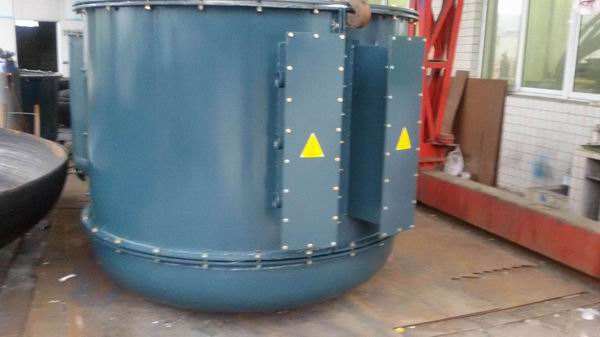
Electric heating furnace
An electric heating furnace is an industrial or laboratory heating device that converts electrical energy into thermal energy. Due to its cleanliness, precision, and ease of automated control, it is widely used in many fields. Depending on the heating medium and structure, it can be mainly divided into two categories: electric resistance heating furnaces and thermal oil electric heating furnaces.
⚡️ Electric Resistance Heating Furnace
This is the most common type of electric heating furnace. Its core principle is Joule's law: when current passes through a conductor with resistance (such as metal resistance wire, silicon carbide rods, molybdenum wire, etc.), electrical energy is converted into thermal energy, raising the temperature of the conductor itself. The generated heat is then transferred to the workpiece or material in the furnace chamber through radiation, conduction, or convection.
Main Features
Wide temperature range: Can heat from room temperature up to 1800°C or even higher, depending on the heating elements and lining materials.
Precise temperature control: With thermocouples and temperature control systems, high-precision temperature control of ±1°C can be achieved.
Uniform heating: Especially in furnace types that primarily use radiation heating, it is easy to achieve a uniform temperature distribution in the furnace.
Clean and pollution-free: The working process produces no smoke or harmful combustion exhaust gases, making it a clean heating method.
Easy operation: Easy to achieve automation and programmed control.
Common Types and Applications
Table
Download as table
Export as image
Type Applicable Scenarios Typical Applications
Box-type resistance furnace Small to medium batch production, laboratories Material heat treatment, ash determination (muffle furnace), sintering
Tube-type resistance furnace Heating long strip/tube-shaped samples under specific atmospheres Crystal growth, material synthesis, semiconductor processing
Pit-type resistance furnace Vertical suspension heating of long shaft workpieces Reducing workpiece deformation, heat treatment
Car-bottom resistance furnace Large, heavy forgings or castings Annealing, normalizing, and other heat treatments of large workpieces
Vacuum/atmosphere resistance furnace When oxidation prevention or specific process environments are needed Powder metallurgy, brazing, high-end material heat treatment
Thermal Oil Electric Heating Furnace
This is a special industrial furnace that uses thermal oil as the heat carrier. Its working principle is: the electric heating element is directly immersed in the thermal oil to generate heat, and then a circulation pump forces the thermal oil to circulate in a closed system in the liquid phase, continuously and stably transferring heat to the heat-using equipment (such as reactors, rollers, molds, etc.). The cooled thermal oil then flows back to the heater to be reheated.
Main Features
Low pressure and high temperature: It can achieve working temperatures up to 350°C or even 400°C at normal pressure or lower pressure (usually <0.4MPa), with high safety.
Intelligent temperature control: Using advanced control systems such as PID, temperature control accuracy can reach ±1°C, with thermal efficiency above 98%.
Closed-loop circulation: Minimal heat loss, no problems of steam boiler leakage (running, emitting, dripping, leaking), energy-saving and environmentally friendly.
Flexible installation: No dedicated boiler room required; it can be installed near the heat-using equipment, occupying a small footprint.
Safe and reliable: Equipped with multiple safety protection systems such as over-temperature, over-pressure, oil shortage, and explosion-proof.
Application Fields
Widely used in industries such as chemical, petroleum, textile, printing and dyeing, plastics and rubber, food processing, wood processing, and building materials, for heating and constant temperature in processes such as distillation, polymerization, drying, melting, shaping, and baking.
How to Choose?
When selecting an electric heating furnace, the following factors should be comprehensively considered:
Process temperature: Clarify the required maximum working temperature and temperature control accuracy. Resistance furnaces are suitable for ultra-high temperatures (>400°C), while thermal oil furnaces are suitable for medium to high temperatures (≤400°C) where uniform heating is needed.
Heating method: Whether to directly heat the workpiece (choose resistance furnace) or need a stable, uniform heat source to indirectly heat equipment or molds (choose thermal oil furnace).
Working environment: Whether vacuum, protective atmosphere, or explosion-proof environment is required.
Production scale: Laboratory small batch (box/tube furnace) or industrial continuous production (car-bottom/belt furnace/thermal oil furnace system).
Compliance and cost: Thermal oil furnaces are special equipment; when purchasing, confirm that the manufacturer has the corresponding boiler manufacturing qualifications. At the same time, the replacement cost of consumables such as heating elements and temperature control systems should be included in the long-term operation and maintenance cost evaluation.