
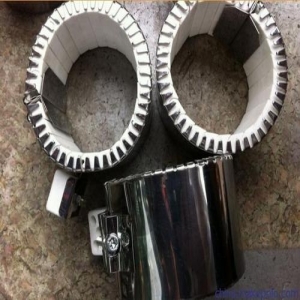
During design and selection, if the original heating ring has low power density and slow heating, or the ceramic skeleton deforms at high temperatures causing poor contact, it will affect the temperature control stability of injection molding, extrusion, and other processes. To address these issues, the DJR-280 ceramic electric heating ring provides a replaceable heating solution.
This heating ring uses a ceramic skeleton wound with resistance wire, protected on the outer layer by a stainless steel braided mesh or metal shell. Compared with mica heating rings, ceramic parts have a higher temperature resistance grade and a small thermal expansion coefficient, maintaining stable shape in the 300–450°C range. During installation, the inner diameter must match the outer wall of the barrel, with a common range of Φ40–Φ300mm, and the length can be customized according to the section to ensure uniform heat transfer on the contact surface.
The rated voltage is 220V or 380V, and the power density is recommended to be controlled at 3–6W/cm² to avoid accelerated oxidation of the resistance wire caused by local overheating. When the surface load is too high, a structure with heat dissipation grooves can be selected. There are two lead wire methods: terminal wiring and high-temperature wire. Design and selection personnel need to confirm according to the equipment wiring space. The cold insulation resistance is not less than 20MΩ, and it withstands 1500V/1min without breakdown.
It is suitable for heating sections of injection molding machine barrels, extruder barrels, blown film machines, as well as heating parts of pelletizers, granulators, and other equipment. Under working conditions requiring frequent start-stop or temperature cycling, the thermal shock resistance of ceramic parts helps extend the replacement cycle.

