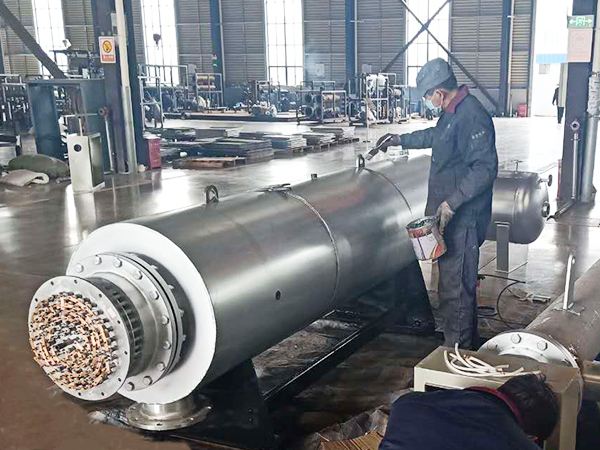

Nonwoven Fabric Heater Factory Price
Nonwoven Fabric Heater Factory Price Introduction:
The heat of a liquid electric heater is generated by the electric heating elements placed inside the heater. The medium is heated through forced convection. The medium enters the container through the inlet, and during heating, the principles of fluid thermodynamics are applied. The huge amount of heat generated by the liquid electric heater during operation is transferred out by the medium as a heat carrier through a pump, achieving continuous heat transfer and meeting the requirements of the process heating. A liquid electric heater uses liquid as the heat transfer medium, heats up through electricity, and provides circulating heat supply through a high-temperature water pump forced circulation.
Product Usage:
It is applied in heat-using occasions where oil is not suitable as a heat transfer medium. The core heating component of the liquid electric heater adopts a tubular clustered structure design, with fast thermal response, high thermal efficiency, and temperature controlled by a microcomputer intelligent dual-temperature dual-control method, with PID automatic adjustment and high temperature control accuracy. It is widely used in processes requiring heating and insulation at working temperatures ≤ 98°C in fields such as petrochemical, textile printing and dyeing, printing industry, pharmaceutical and medical, etc. The main components are configured with high-quality products, ensuring long service life, safety, and environmental friendliness.
Circulating liquid electric heaters heat fluids through forced convection by a pump, which is a heating method with forced circulation. Circulating electric heaters have the characteristics of small size, high heating power, and high thermal efficiency. Their working temperature and pressure are high, with a maximum working temperature of up to 600°C and pressure resistance up to 20MPa. The structure of circulating electric heaters is sealed and reliable, without phenomena such as "leakage, dripping, or seepage." The medium is heated uniformly, and the temperature rises rapidly and stably, enabling automatic control of parameters such as temperature, pressure, and flow rate.
Technical Parameters of Liquid Electric Heaters:
Liquid electric heaters are mainly used for heating liquids such as acid and alkali solutions, chemical reagents, water, oil, etc. The surface metal sheath material is mainly stainless steel, such as 304, 316 stainless steel, etc., which has advantages such as high mechanical strength, heat resistance, corrosion resistance, and resistance to scaling.
Technical Indicators of Liquid Electric Heaters
1. Power deviation: +5~ -10%
2. Cold insulation resistance: ≥50MΩ 3. Insulation withstand voltage: 200V working voltage is 1500V/1min, 380V working voltage is 2000V/1min. Instructions for using liquid electric heaters:
3. The working voltage should not exceed 1.1 times the rated value, and the shell should be effectively grounded.
4. The effective heating length must be fully immersed in water to avoid dry burning.
5. Scale on the tube surface should be removed regularly to avoid affecting heat dissipation and shortening service life.
6. The element should be stored in a dry place. If the insulation resistance is lower than 1MΩ due to long-term storage, it can be heated by reducing voltage or dried in an oven until the insulation resistance is restored.
7. When tightening the wiring screws, avoid excessive force.
Working Process of Liquid Electric Heaters:
According to the installation form, it can be divided into horizontal fluid electric heaters and vertical fluid electric heaters. The heated medium is input by the pump pressure, absorbs heat during the flow process, reaches the temperature required by the user's process, and is sent to the user end. Through the intelligent temperature control device and electric power regulation system at the outlet, the fluid medium temperature can meet the user's process requirements. At the same time, with the help of internal sensors and various protective devices, once the medium temperature exceeds the set temperature range of the equipment, the intelligent temperature control system will respond quickly, stop heating operation, and prompt fault alarms to avoid damage to the heating equipment.