
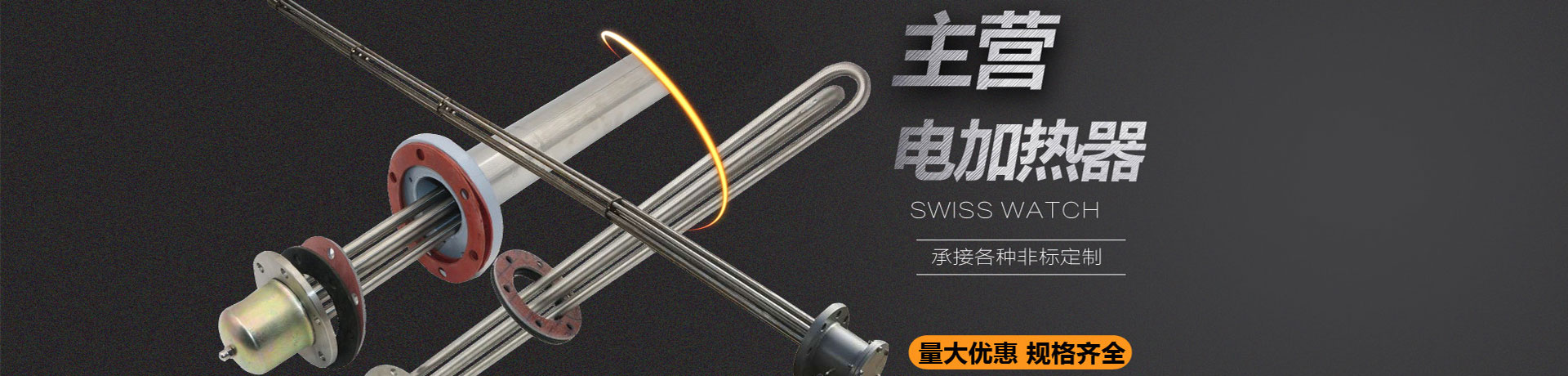

Complete Range of Sheathed Heaters
Precautions: 1. The element is allowed to work under the following conditions: A. Relative humidity of air not greater than 95%, no explosive or corrosive gases. Except for explosion-proof heaters B. Working voltage should not exceed 1.1 times the rated value, and the housing should be effectively grounded. C. Insulation resistance ≥1MΩ Dielectric strength: 2KV/1min. 2. The electric heating tube should be properly positioned and fixed. The effective heating zone must be fully immersed in liquid or solid metal; dry burning is strictly prohibited. If scale or carbon deposits are found on the tube surface, they should be cleaned promptly before reuse to avoid affecting heat dissipation and shortening service life. 3. When heating fusible metals or solid nitrates, alkalis, asphalt, paraffin, etc., the operating voltage should be reduced first, and only after the medium melts can the voltage be raised to the rated value. 4. When heating air, the elements should be arranged crosswise and evenly to ensure good heat dissipation conditions and allow the flowing air to be fully heated. 5. When heating nitrates, safety measures should be considered to prevent explosion accidents. 6. The wiring part should be placed outside the insulation layer to avoid contact with corrosive, explosive media, and moisture; the lead wires should be able to withstand the temperature of the wiring part and the heating load for a long time. When tightening the wiring screws, avoid excessive force. 7. The element should be stored in a dry place. If the insulation resistance drops below 1MΩ due to long-term storage, it can be dried in an oven at about 200°C, or heated by reducing voltage until the insulation resistance is restored. 8. The magnesium oxide powder at the outlet end of the electric heating tube should be protected from pollutants and moisture at the usage site to prevent leakage accidents.
|