
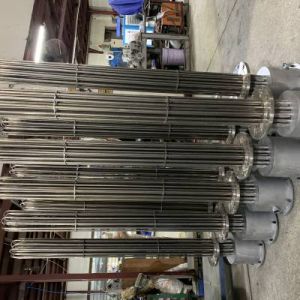
Field observation: During the commissioning of a hydraulic station, the oil tank temperature failed to reach the set value for a long time, and a slight burnt smell was detected near the heater terminals. Upon disassembly and inspection, local carbonization was found on the tube wall. Such problems often point to the same issue—improper matching of power density and medium during sheathed electric heater selection. The following summarizes common questions from the perspective of design and selection.
A: An ordinary electric heating tube has an integrated single-layer structure, with the heating core in direct contact with the medium; a sheathed electric heater uses a three-layer coaxial composite of "core wire—insulation—sheath," with the core separated from the sheath. The heat transfer path is: the resistive core wire generates Joule heat, which is radially conducted through the insulating layer such as magnesium oxide powder to the inner wall of the metal sheath, and then transferred from the outer surface of the sheath to the medium by convection, radiation, or contact conduction. The sheath serves as mechanical protection and a chemical barrier. During replacement, only the core is extracted and replaced, without draining the oil tank.
A: For oil media, the recommended surface heating power should not exceed 0.7 W/cm². Excessive power density will cause the local tube wall temperature to exceed the carbonization threshold of the oil, forming coke and further deteriorating heat exchange. The same limit applies to heat transfer oil systems, and 304 or 316L stainless steel sheaths are recommended. Under conventional working conditions, the operating temperature should not exceed 300°C and the pressure should not exceed 0.8 MPa; high-pressure custom designs can reach 10–20 MPa.
A: For water and soft water, 304 stainless steel can be used, and the power density can be relaxed to 5–10 W/cm²; for weakly corrosive media, choose 316L stainless steel; for strongly corrosive media, choose titanium alloy or Hastelloy. Air heating must be equipped with a finned structure, with a power density of 1–2 W/cm², and dry burning without fins is strictly prohibited. Explosion-proof products can reach explosion-proof grade dⅡCT4 and protection grade IP65, suitable for enclosed oil and gas environments. The electrothermal conversion efficiency is not less than 95%, and the allowable working voltage error is not greater than 1.1 times the rated value.

