
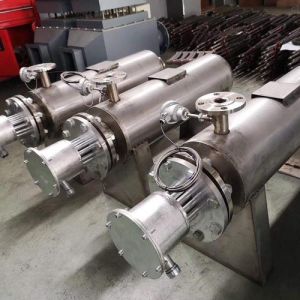
During on-site inspections, if the heat transfer oil furnace is found to heat up slowly and have large temperature fluctuations, and when the sheathed heater core is removed, coking on the surface or a decrease in insulation resistance is often seen. This situation is mostly related to the selection of an excessively high surface power density or oil degradation.
Surface power density is the electrical power carried per unit heating area, which directly determines the sheath surface temperature. When the density is too high, the heat transfer oil is prone to cracking and coking at high temperatures, forming an insulating layer, further raising the core temperature, and causing the resistance wire to burn out. During selection, a reasonable value should be determined based on the oil type and flow rate. For example, for heat transfer oil systems, it is recommended that the sheath surface power density not exceed 0.7W/cm² and the core not exceed 1.8W/cm², which can slow down the tendency to carbonize. If the actual working conditions have low flow rate or the oil is aged, it should be further reduced appropriately.
SRY9-1 adopts a core-tube separation design, with the heating core inserted inside the protective sleeve tube, and the junction box connected to the protective sleeve tube flange. When the core fails, it is only necessary to cut off the power, loosen the junction box bolts, and pull out the core for replacement, without draining the oil tank. This reduces downtime and medium loss, and is suitable for heat transfer oil systems with continuous production. The protective sleeve tube remains in place, also avoiding leakage that may be caused by repeated disassembly and assembly of the sealing surface.
This model of sheathed electric heater is suitable for voltages of 220V or 380V, with power customized as needed. The protective sleeve tube material is usually stainless steel 304 or 316L, and the flange specifications can match standard oil tank interfaces. The heater can be equipped with temperature control interfaces and oil inlet and outlet ports for independent control. It is mainly used in heat transfer oil furnaces, hydraulic station oil tanks, lubricating oil tanks, and other occasions requiring precise temperature control, especially suitable for heat transfer oil systems with high anti-carbonization requirements.
Regularly measure the insulation resistance of the heater. If it is lower than 1MΩ, check for moisture or coking. Observe whether there is carbon deposit on the outer wall of the protective sleeve tube, and clean it if necessary. Check whether the wiring terminals are loose to avoid overheating caused by excessive contact resistance. If the system heats up significantly slower, the core can be pulled out to check whether the surface load exceeds the standard or whether the oil quality has deteriorated.

