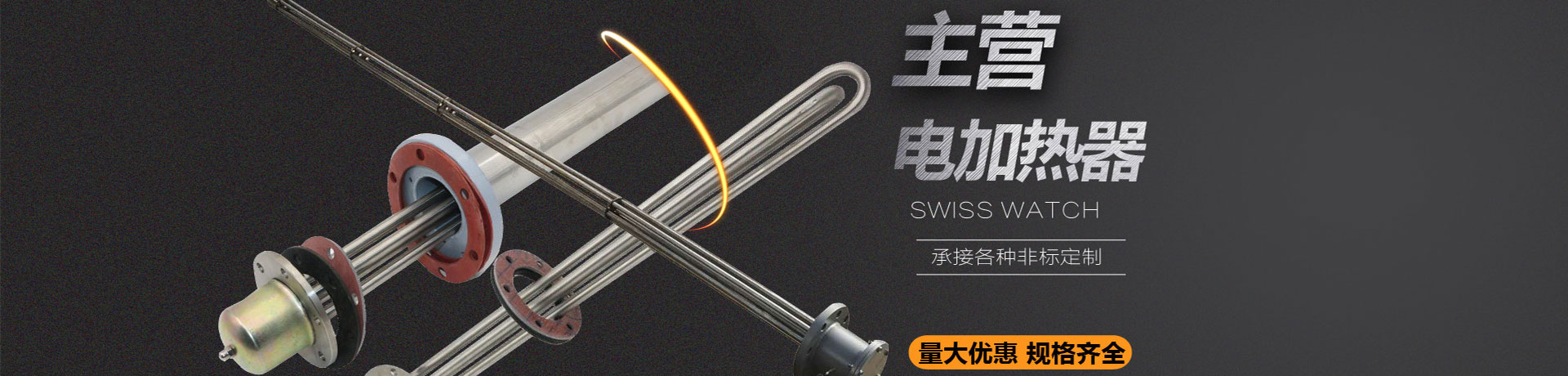
Feedback from operation and maintenance sites frequently centers on the same issue: when the surface load of a sheathed electric heater does not match the medium temperature, oil-based media tend to form carbon deposits on the tube wall, while water-based media tend to form scale; both raise the tube body temperature and shorten element life. The RJY-30 model adapts parameters specifically for this link, and the following explains the issues and corresponding solutions item by item.
Surface power density directly determines the tube wall temperature. For oil-based media, it is recommended to control it at 1–3 W/cm²; for air heating with a finned structure, 1–2 W/cm²; for water-based media, 5–10 W/cm². The RJY-30 model allocates surface load according to medium type, with a power range of 1 kW to 6000 kW and an operating voltage of 220 V or 380 V. When selecting, first confirm the medium and then determine the power density, avoiding working backward from power.
The effective heating area must be fully immersed in liquid or solid metal; dry firing is strictly prohibited. During operation and maintenance, attention should be paid to the matching relationship between surface load and medium temperature, and scale or carbon deposits on the tube surface should be removed promptly. The operating voltage must not exceed 1.1 times the rated value, and the shell must be reliably grounded. When the insulation resistance is below 1 MΩ, it can be restored by drying in an oven at 200°C.
The design operating temperature can reach 650°C, with a typical operating temperature range of 300°C to over 2000°C, depending on the sheath and resistance wire materials. Pressure-bearing capacity is 1.0–8 MPa, with high-pressure customization up to 20 MPa; explosion-proof rating can reach Ex db IIC T1-T6 Gb, and protection rating can reach IP65. Electrical-to-thermal conversion efficiency is not less than 98%, and service life is 10,000–50,000 hours.
Threaded connections are suitable for hydraulic oil tanks, flange connections are suitable for large storage tanks, and structures can be straight tube, U-shaped, or W-shaped. Applications cover jacketed heating of petrochemical reactors and pipeline heat tracing for freeze protection, oil heating in hydraulic and lubrication systems, heating of semiconductor vacuum chambers and lithography machine heating plates, sintering of lithium battery materials and preheating of electrolytic cells, lubricating oil heating in wind turbine gearboxes, and high-pressure sterilization and heat-sealing processes in food and pharmaceutical industries. During operation, the matching of surface load and medium temperature should be used as a reference item for inspection.