
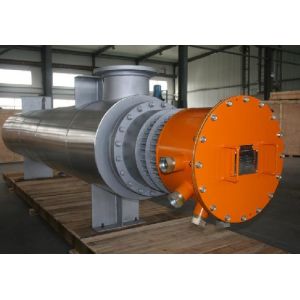
In the daily maintenance of hydraulic stations, lubricating oil tanks, or reducer oil sumps, oil viscosity increases as the ambient temperature drops, which affects pumping and system response. Tubular electric heaters isolate the heating core from the oil through a metal sheath tube and are directly inserted into the oil tank or pipeline to heat the medium and reduce viscosity. The JRH-600 model uses threaded connection installation, and the power density is controlled at 1~3W/cm² according to oil working conditions, which can reduce the tendency of oil carbonization and coking and extend the oil replacement cycle.
Reactor jackets, heat transfer oil circulation systems, and heavy oil and diesel transportation pipelines often require a stable heat source to ensure fluidity. This model can match 220V or 380V voltage according to on-site power supply conditions, with power covering pipeline-type specifications from 1kW to 6000kW. The sheath tube material can be selected from 304, 316L stainless steel, or titanium tube to adapt to different corrosive media; the internal magnesium oxide powder, after being compacted by tube shrinking, can reach a density of 3.3g/cm³ or more, with a breakdown voltage of no less than 1500V, balancing insulation and heat conduction.
Natural gas pressure reducing stations, hot water circulation pipelines in high-rise buildings, and anti-freezing of solar pipelines usually require heating elements arranged along the pipeline. Tubular electric heaters can be made into straight tube, U-shaped, or W-shaped structures, and with temperature sensor signals, automatically adjust output power to keep the outlet medium temperature uniform. When the heating element overheats, an independent overheat protection device cuts off the heating power supply to prevent the material from deteriorating or carbonizing due to continuous overheating.
Lithium battery material sintering furnaces and hydrogen electrolyzer preheating links have requirements for heat source cleanliness and temperature control accuracy. Tubular electric heaters can be customized with high-temperature structures as needed and used with protection grades IP54~IP65 or explosion-proof designs (Ex db IIC T1-T6). Their electric-to-heat conversion efficiency can reach over 98%, and they can maintain safe operation even in enclosed oil and gas environments. For scientific research scenarios such as nuclear fusion experimental devices and space simulation chambers, products with specific materials and pressure ratings can be provided.
When selecting models, purchasers can confirm from four dimensions: heating medium, power density, supply voltage, and installation method: for clean water heating, 304 stainless steel is generally selected; for oil, the power density is controlled at 1~3W/cm²; for corrosive media, 316L or titanium tube is preferable. Installation can use threaded or flange connections, and the heating core can be replaced without draining the oil tank, helping to reduce downtime costs. The product complies with JB/T 12233-2015 "Sheathed Electric Heaters" and JB/T 2379-93 related standards, and under normal working conditions, its service life can reach 10,000~50,000 hours.

