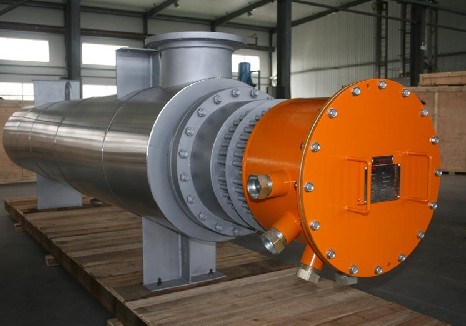
Explosion-proof Electric Heater
An explosion-proof electric heater is an electric heating device specifically designed for flammable and explosive hazardous environments. It converts electrical energy into thermal energy to heat liquid, gaseous, or solid media, and is widely used in places with explosive gases or vapors, such as chemical, petroleum, natural gas, military, marine, and mining industries.
Working Principle
Low-temperature fluid media enters the heater from the inlet under pressure, flows through the internal specific heat exchange channels, absorbs the high-temperature thermal energy generated by the electric heating elements, and exits from the outlet after the media temperature rises. The internal control system automatically adjusts the output power based on the outlet temperature sensor signal to ensure uniform and stable media temperature. When the heating element overheats, an independent overheat protection device immediately cuts off the power supply to prevent material coking, deterioration, or element burnout.
Its core explosion-proof principle lies in the flameproof device installed in the junction box, which effectively isolates or eliminates potential internal sparks, preventing ignition of flammable explosive gases or dust in the external environment.
Main Features
High Efficiency and Energy Saving: Thermal efficiency is close to 100%, with 99% of the heat generated by electrical energy transferable to the heating medium.
Compact Size, High Power: Compact structure, with a maximum single-unit power of up to 3000kW.
High Temperature Control Accuracy: Up to ±0.2°C, supporting fully automatic temperature control via DCS systems.
High Heating Temperature: The design working temperature typically reaches 720°C, with some models up to 850°C.
Multiple Safety Protections: Over-temperature protection, low liquid level/dry-burn protection, pressure/flow interlock control.
High Protection Level: Typical products have a protection rating of IP66 and can withstand pressure up to 20MPa.
Environmentally Friendly and Pollution-Free: The heating process produces no harmful substances.
Explosion-proof Ratings and Standards
Table
Download as Table
Export as Image
Item Parameter
Explosion-proof Marking Ex d ⅡB T4 Gb / Ex d ⅡC T4 Gb
Applicable Zones Zone 1, Zone 2 (gas); Zone 21, Zone 22 (dust)
Gas Group Class ⅡA, ⅡB, ⅡC explosive gas atmospheres
Temperature Class T1~T4
Executive Standards GB 3836 series (GB 3836.15—2024 selection standard)
International Certifications Some products have ATEX and IECEx certifications
Protection Level IP66
Equipment selection must comply with national standard GB 3836.15—2024 and ensure the acquisition of the complete machine explosion-proof certificate.
Product Structure
Control and Wiring Enclosure: Die-cast aluminum alloy ZL102, after high-speed shot blasting, treated with fully automatic high-voltage electrostatic powder spraying and thermal curing processes.
Heating Element Enclosure: Stainless steel material, internally using high-temperature resistant insulating adhesive pressure-injected molded electric heating body.
Electric Heating Elements: Composed of heating wire, magnesium oxide insulating filling layer, and metal protective tube; some high-end models adopt double protective tube structure to enhance explosion-proof performance.
All exposed fasteners: Stainless steel material.
Typical Application Scenarios
Table
Download as Table
Export as Image
Industry Application Content
Petrochemical Heating of hydrocarbons such as crude oil, heavy oil, fuel oil, heat transfer oil, and paraffin.
Chemical Material temperature raising, powder drying, spray drying, reactor heating.
Marine & Offshore Preheating of fuel oil/lubricating oil, cargo oil tank insulation, inert gas system heating (requires classification society certification).
Military & National Defense Medium heating in special environments.
Mining Fluid heating in flammable and explosive gas environments.
General Liquid heating in containers such as water tanks, oil tanks, reaction towers, and storage tanks.
Usage Precautions
Must be used in conjunction with temperature interlock control protection devices such as thermocouples.
The 100mm range near the flange surface of the heating tube is the non-heating part. During use, the heating part must be immersed more than 50mm below the medium to be heated.
After installation, the sealing between the flange and the box body must be checked.
When selecting equipment, the type of explosive gas/dust, zone classification, and temperature class must be clearly defined to ensure the explosion-proof rating matches.
Market Size
According to industry reports, the global market size of explosion-proof industrial electric heaters reached 17.35 billion RMB in 2025 and is expected to approach 24.30 billion RMB by 2032, with a compound annual growth rate of approximately 4.9%. During the same period, the Chinese market size exceeded 14.86 billion RMB, a year-on-year increase of 10.9%, showing a steady medium-to-high growth trend.