
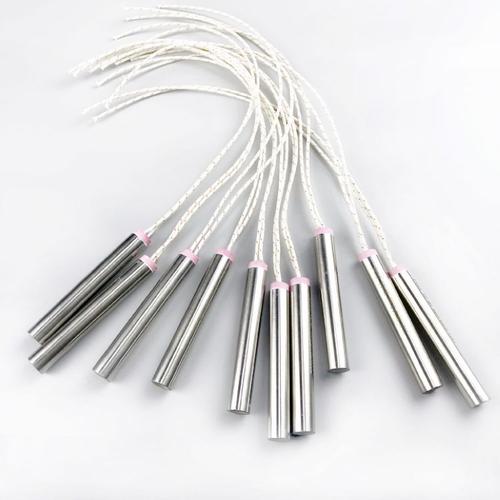
During on-site maintenance, problems such as overheating of terminal blocks, bending of the rod body, or decreased insulation resistance are often found during the disassembly and assembly of steam turbine bolt heating rods. Design and selection personnel need to compare and analyze from the three dimensions of structure, electrical parameters, and installation dimensions in order to match the actual working conditions.
Common bolt electric heating rods are divided into two structures: rigid straight rods and flexible bendable rods. Rigid straight rods are suitable for occasions where the straightness of the bolt center hole is good, and coaxiality must be ensured during installation to avoid damage to the tube wall caused by forced insertion. The flexible bendable structure allows a certain curvature and is suitable for arrangement around nuts in confined spaces, but the bending radius should not be too small, otherwise it may affect the service life of the internal heating wire. During selection, the actual straightness and hole diameter tolerance of the bolt center hole should be confirmed.
The rated working voltage is 220±20V. During design and selection, the fluctuation range of the on-site power supply voltage needs to be calculated. The power density of a single heating rod is related to the bolt specifications and the heating time requirements: too high a power density may cause the local temperature to exceed the tempering temperature of the bolt material, while too low a power density will prolong the preheating time. It is recommended to calculate the required total power based on the bolt mass, target temperature rise, and allowable heating time, and then allocate it to a single heating rod. The insulation resistance should meet the requirements of relevant standards under cold conditions, and during selection, attention should be paid to the test data provided by the manufacturer.
The diameter of the bolt electric heating rod should maintain a reasonable clearance with the bolt center hole. If the clearance is too small, insertion is difficult and it may become stuck after thermal expansion; if the clearance is too large, heat transfer efficiency decreases. It is usually recommended to control the unilateral clearance between 0.2 mm and 0.5 mm, and the specific value should be determined in combination with the thermal expansion coefficient of the bolt material. In terms of length, the effective heating zone of the heating rod should cover the threaded section of the bolt to avoid insufficient heating of the threaded part. Sufficient space should be reserved at the terminal to prevent interference with surrounding components.
This product is mainly used for bolt disassembly and assembly preheating of equipment such as steam turbines, gas turbines, and large compressors. During selection, the following checklist can be used to confirm item by item: bolt specifications and center hole dimensions, maximum working temperature, power supply voltage and power, single heating time, insulation grade, wiring method, and whether temperature measuring points are required. For high-temperature alloy bolts, it is also necessary to confirm whether the outer shell material of the heating rod is compatible with the bolt material to avoid elemental diffusion or electrochemical corrosion at high temperatures.

