
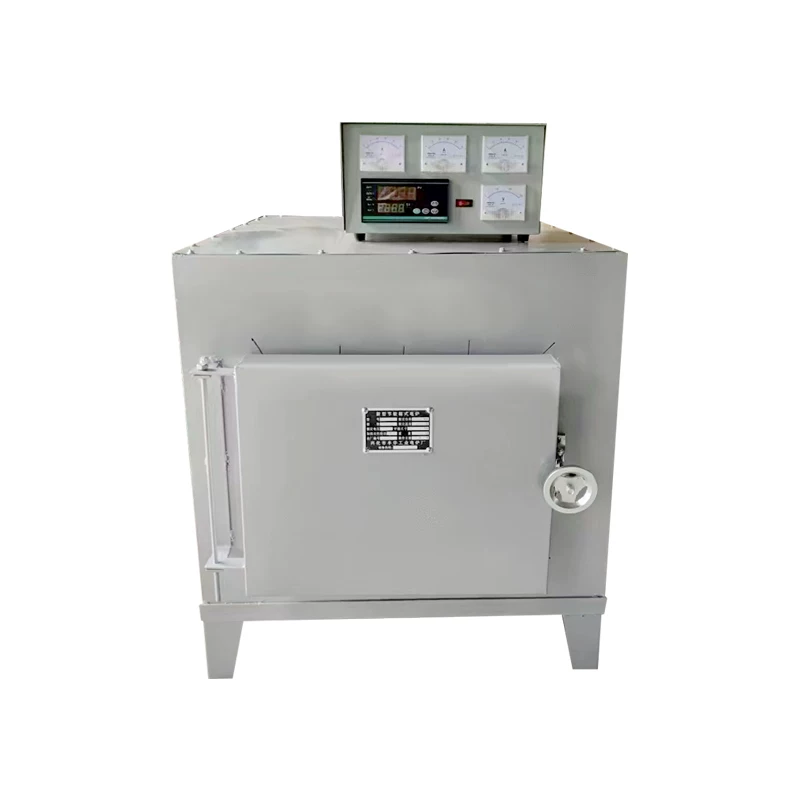
Electric Heating Furnace
An electric heating furnace is an industrial device that converts electrical energy into thermal energy to heat, melt, or heat-treat materials. With advantages such as precise temperature control, uniform heating, and environmental cleanliness, it has become the mainstream heating choice in modern industry.
Core Working Principle
The core of an electric heating furnace is to efficiently convert electrical energy into thermal energy, mainly through the following two methods:
Resistance heating: This is the most common form. When current passes through heating elements with high electrical resistivity (such as resistance wires, silicon carbide rods, molybdenum disilicide rods, etc.), heat is generated according to Joule's law (Q=I²Rt). The heat is then transferred to the workpiece in the furnace chamber through radiation, conduction, or convection.
Electromagnetic induction heating: Utilizing the principle of electromagnetic induction, an alternating magnetic field induces eddy currents inside the metal workpiece, causing the workpiece to heat up due to its own resistance. This method generates heat directly inside the workpiece, resulting in fast heating speed and low heat loss.
The temperature inside the furnace is monitored in real-time by sensors such as thermocouples, and the input power is automatically adjusted through a PID controller to achieve precise temperature control.
Precise temperature control: Temperature control accuracy can generally reach ±1°C, supporting multi-stage programmed heating and automatic constant temperature, meeting the needs of precision heat treatment.
Good heating uniformity: The temperature field distribution inside the furnace is uniform, effectively ensuring product quality and reducing deformation and stress.
Environmental cleanliness: The working process involves no combustion, no smoke, no dust, and no harmful gas emissions. There is no need for fuel storage or ash disposal, and the working environment is clean.
High degree of automation: Generally equipped with over-temperature alarms, broken thermocouple protection, leakage protection, and other safety mechanisms, making operation simple and labor intensity low.
High thermal efficiency: The electrical-to-thermal conversion efficiency is close to 100%. The comprehensive thermal efficiency of industrial resistance furnaces can reach 50%-80%, and thermal oil furnaces can reach over 90%.
Strong adaptability: The working temperature range is extremely wide, from room temperature to 3000°C, with corresponding furnace types available. It also supports various process environments such as vacuum, inert gas, and reducing atmospheres.
Common Types and Specifications
Electric heating furnaces come in many varieties and can be classified according to different dimensions:
Table
Download as Table
Export as Image
Classification Dimension Main Types Typical Applications/Features
By heating principle Resistance furnace, induction furnace, arc furnace Resistance furnace is most widely used; induction furnace heats quickly, suitable for quenching and melting
By furnace structure Box furnace, pit furnace, car-bottom furnace, tube furnace, vacuum furnace Box furnace has strong versatility; pit furnace is suitable for long shaft workpieces; car-bottom furnace carries large workpieces
By process purpose Annealing furnace, quenching furnace, tempering furnace, carburizing/nitriding furnace Highly targeted, meeting the different stages of metal heat treatment and surface strengthening needs
By working temperature Low-temperature furnace (<650°C), medium-temperature furnace (650-1000°C), high-temperature furnace (>1000°C) Covers a wide range of temperature needs from drying, tempering to sintering, and melting
Examples of common specification parameters:
Temperature range: from digital display temperature-adjustable furnaces at 400°C to ultra-high-temperature experimental furnaces at 1700°C or even 3000°C.
Power range: small experimental furnaces 1-4kW, medium furnaces 8-18kW, large industrial furnaces can reach above 110kW.
Furnace chamber size: from small experimental furnaces of 80×120×200mm to large box furnaces of 1500×800×800mm.
Power supply requirements: small power equipment uses AC220V, while medium and large equipment generally uses AC380V three-phase electricity.
Main Application Fields
The application of electric heating furnaces almost runs through all industrial fields that require thermal processing:
Metallurgy and machinery: heat treatment of metals such as annealing, normalizing, quenching, tempering, carburizing, and nitriding, as well as brazing, sintering, and melting.
New materials and chemicals: ceramic/glass sintering, powder metallurgy, crystal growth, catalyst activation, drying, and roasting.
Electronics and semiconductors: semiconductor processing, component firing, and photovoltaic material preparation.
Light industry and food: textile printing and dyeing setting, rubber and plastic vulcanization, wood drying, and food baking and dehydration.
Scientific research and laboratories: material analysis, sample ashing, and various high-temperature experiments (such as muffle furnaces)