
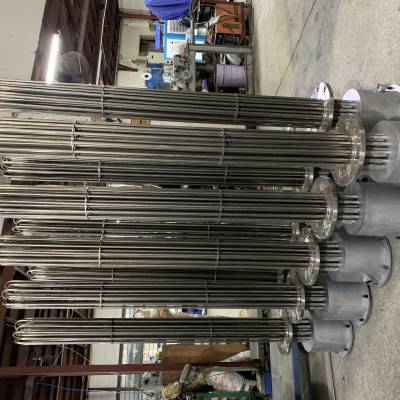
When selecting a shell and tube heat exchanger, designers often encounter the problem that heat exchange area and pressure drop are difficult to balance. The GCH-220 shell and tube heat exchanger was developed based on common operating conditions. The following points list its design parameters and application boundaries.
The design pressure of this model is 1.6 MPa, and the design temperature covers -20°C to 150°C. During selection, it is necessary to separately confirm whether the actual working pressure and temperature of the tube side and shell side are within this range, and to pay attention to material toughness and sealing component cold resistance under low-temperature conditions.
The heat exchange area can be adjusted between 1.5 and 12 square meters according to heat load and temperature difference. Designers should calculate the required area based on the allowable pressure drop to avoid excessively low flow velocity and increased fouling tendency caused by excessive area margin.
It is necessary to separately clarify the corrosiveness, fouling tendency, and phase state of the media on both sides. Media prone to fouling should preferably flow through the tube side for easy cleaning, while media with higher viscosity or lower flow rate may be considered for the shell side with baffles installed.
During operation, observe the readings of pressure gauges and thermometers. If the pressure difference between inlet and outlet rises by more than 0.05 MPa above the initial value, cleaning should be arranged. The cleaning cycle should be determined based on the degree of medium contamination and the trend of pressure difference changes.
When comparing different schemes, attention can be paid to design pressure, design temperature, heat exchange area, medium characteristics of the tube side and shell side, and allowable pressure drop. It is recommended to compare the above parameters with the actual operating curve of the system to avoid selecting solely based on a single parameter.
The GCH-220 shell and tube heat exchanger is suitable for HVAC, light industry, and general industrial cooling or heating circuits, and is not suitable for strongly corrosive or severely vibrating occasions. Specific selection needs to be calculated in combination with process conditions and relevant standards.

